

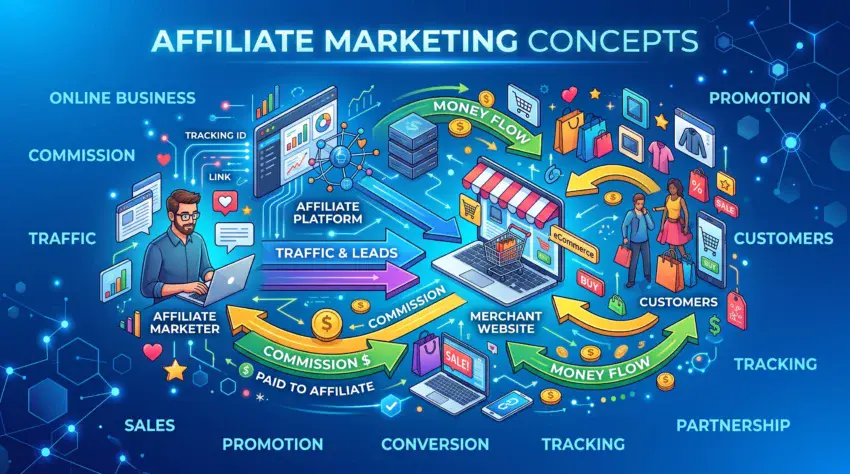
Affiliate Marketing for Beginners: The Complete Guide
Affiliate marketing can be an exciting way to begin building an online income stream without creating your own products, managing inventory, or dealing with shipping and fulfillment.
But if you’re new to affiliate marketing, it can also feel overwhelming. There are countless programs, platforms, products, strategies, and opinions about what works.
The good news is that you don’t need to master everything at once.
At Easy Monitize, the goal is to make online income easier to understand. This guide walks you through the fundamentals of affiliate marketing: how it works, how to choose a niche, how to find affiliate programs, how to create content, and how to build a sustainable affiliate business.
Whether you’re interested in affiliate marketing with a website or want to explore affiliate marketing without a website, this guide will give you a roadmap for getting started.
What Is Affiliate Marketing?
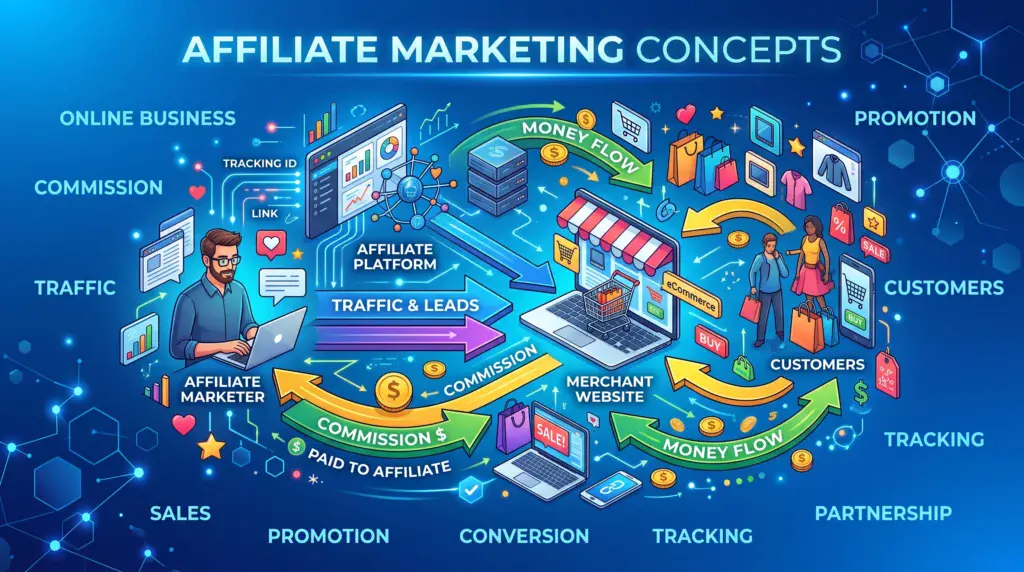
Affiliate marketing is a type of online marketing where you promote another company’s product or service and earn a commission when someone makes a qualifying purchase or completes another specified action through your referral.
Instead of creating your own product, you become the connection between the customer and the company selling the product.
A typical affiliate marketing relationship involves three primary participants:
- The Merchant: The company or individual selling the product or service.
- The Affiliate: The person who promotes the product or service.
- The Consumer: The person who clicks the affiliate’s link and makes a purchase or completes a qualifying action.
Affiliate marketing allows you to focus on things like content creation, education, recommendations, and promotion rather than inventory, shipping, or customer fulfillment.
It can be used in almost any industry, including technology, software, education, finance, fashion, home products, business services, and more.
How Does Affiliate Marketing Work?
The basic process is relatively simple.
You join an affiliate program and receive a unique tracking link. You then place that link within appropriate content, such as a blog post, product review, tutorial, video, email, or social media content.
When someone clicks your link and completes the action required by the affiliate program, the transaction is tracked, and you may receive a commission.
The process generally looks like this:
Merchant → Affiliate → Consumer → Purchase or Qualifying Action → Commission
Affiliate programs use tracking technology to identify which affiliate referred the customer. Depending on the program, commissions may be paid for sales, leads, sign-ups, free trials, or other qualifying actions.
Payment terms vary considerably between programs, so always review the specific affiliate program’s terms before promoting it.
Why Do People Choose Affiliate Marketing?
Affiliate marketing appeals to beginners because you don’t necessarily need to create your own product to get started.
You can build an audience around a topic you’re interested in and recommend products or services that genuinely help that audience.
Some potential advantages include:
- Relatively low startup costs compared with creating a physical product
- No inventory to manage
- No product fulfillment
- Flexible working arrangements
- The ability to work across multiple platforms
- Opportunities to build valuable digital marketing skills
- The potential to create income from evergreen content
Affiliate marketing can also complement other online business models.
For example, a blogger might use affiliate marketing alongside advertising or digital products. An online entrepreneur might use affiliate marketing together with email marketing. A content creator might recommend software or products relevant to their audience.
The key is to think of affiliate marketing as a business model and marketing strategy, not a get-rich-quick scheme.
Can Affiliate Marketing Create Passive Income?
You may hear affiliate marketing described as passive income.
There is some truth behind the concept, but it’s important to have realistic expectations.
Creating an article, video, tutorial, or resource that continues attracting visitors months or years after publication can potentially generate affiliate clicks and commissions without requiring you to recreate that content every day.
However, successful affiliate marketing usually requires ongoing work.
You may need to:
- Update old content
- Replace discontinued products
- Check affiliate links
- Research new products
- Improve SEO
- Respond to your audience
- Test different calls to action
- Update outdated information
- Monitor your results
A better way to think about affiliate marketing is building assets that can continue working for you over time.
How to Start Affiliate Marketing
If you’re completely new to affiliate marketing and want a structured learning environment, you may also want to read my Wealthy Affiliate Review for Beginners before deciding whether the platform is right for you.
If you’re wondering how to start affiliate marketing, don’t let all the available options make the process more complicated than it needs to be.
A simple roadmap looks like this:
- Learn the basics.
- Choose a niche.
- Research your audience.
- Find relevant affiliate programs.
- Choose your platform.
- Create useful content.
- Build traffic and an audience.
- Add relevant affiliate recommendations.
- Track your results.
- Improve and expand.
Let’s look at each step.
Step 1: Learn the Basics of Affiliate Marketing
Before signing up for dozens of affiliate programs, take some time to understand how affiliate marketing works.
Learn about:
- Affiliate programs
- Affiliate networks
- Tracking links
- Commissions
- Cookies and attribution
- Conversion rates
- Content marketing
- Search engine optimization
- Email marketing
- Affiliate disclosures
You don’t need to become an expert before getting started.
You simply need enough knowledge to make informed decisions and avoid common beginner mistakes.
Step 2: Choose an Affiliate Marketing Niche
Choosing a niche is one of the most important decisions you’ll make.
A niche is the specific subject or market your website, channel, or online presence focuses on.
A broad topic such as “technology” can contain thousands of possible subjects.
A more focused topic might be:
- AI tools for small businesses
- Blogging tools for beginners
- Home office technology
- Accounting software for small businesses
- Online business tools
- Productivity software
A good affiliate marketing niche should ideally have:
- Products or services people actually purchase
- An audience with identifiable problems or needs
- Affiliate programs you can participate in
- Enough content opportunities to build a substantial resource
- A subject you can realistically write about for the long term
Choose a Niche You Can Stick With
One mistake beginners make is choosing a niche simply because they believe it will make the most money.
Profitability matters, but it isn’t the only consideration.
If you don’t enjoy researching the subject or have no interest in learning about it, consistently creating useful content can become difficult.
Look for the intersection between:
Your interests + Audience demand + Monetization opportunities
That is often a much better starting point.
Step 3: Research Your Audience
Before choosing products to promote, understand the people you’re trying to help.
Ask:
- What problems are they trying to solve?
- What questions are they asking?
- What products are they researching?
- What are they comparing?
- What information do they need before making a purchase?
- What mistakes are they trying to avoid?
The better you understand your audience, the easier it becomes to create content that actually helps them.
Step 4: Find Affiliate Programs
Once you have a niche, you can begin looking for affiliate programs.
There are two common places to find them.
Affiliate Networks
Affiliate networks bring together merchants and affiliates.
Examples include:
- Awin
- CJ Affiliate
- Partnerize
- ShareASale
- Amazon Associates
Networks can make it easier to discover multiple programs from one location.
Direct Affiliate Programs
Some companies operate their own affiliate programs rather than using a large network.
These programs are often found by visiting a company’s website and looking for an “Affiliate,” “Partners,” or similar link.
Examples of companies that have offered affiliate programs include Shopify, Bluehost, and Semrush.
Affiliate programs change over time, so always verify current program availability, commission rates, requirements, and terms directly with the company before promoting an offer.
There are a lot of affiliate marketing platforms and training programs available, so it’s worth doing your research before committing to one. If you’re considering Wealthy Affiliate, I’ve put together a detailed Wealthy Affiliate Review where I take a closer look at the platform, what it offers beginners, its costs, and what you should know before joining.
What Should You Look for in an Affiliate Program?
Don’t automatically choose the program with the highest commission.
Consider:
- Product quality
- Company reputation
- Commission structure
- Cookie or attribution period
- Payment terms
- Recurring commissions
- Customer support
- Affiliate resources
- Program restrictions
- Whether the product actually fits your audience
A great affiliate program is one that offers something your audience genuinely needs.
Step 5: Decide Where You Will Promote Your Content
You don’t necessarily need a website to begin affiliate marketing.
Possible platforms include:
- A website or blog
- YouTube
- Social media
- Email newsletters
- Online communities
- Other content platforms that permit affiliate promotions
However, there is an important distinction between using someone else’s platform and building an asset you control.
A website gives you more control over your content, branding, search visibility, user experience, and email-list growth.
For that reason, a website can be an especially valuable long-term home base for affiliate marketing.
Affiliate Marketing Without a Website
One of the most common questions beginners ask is:
Can you do affiliate marketing without a website?
Yes, depending on the affiliate program’s rules and the platform’s policies.
YouTube
You can create tutorials, demonstrations, comparisons, and product reviews and potentially place qualifying affiliate links where permitted.
Social Media
Platforms such as Facebook, Instagram, Pinterest, TikTok, and others can potentially be used to build an audience and share relevant recommendations.
Always follow the platform’s rules and clearly disclose affiliate relationships when required.
Email Marketing
An email newsletter can provide a direct way to communicate with an audience and recommend useful products or services.
However, not every affiliate program permits affiliate links in emails, so check the program’s terms.
Online Communities
Forums, groups, and Q&A communities can help you build credibility by answering questions.
The focus should be on being genuinely helpful rather than dropping affiliate links wherever possible. Community rules should always be followed.
Should You Build an Affiliate Marketing Website?
For anyone interested in building a long-term affiliate business, I believe a website is worth serious consideration.
Your website can become your central online home.
You can publish:
- Product reviews
- Tutorials
- Comparison articles
- Buying guides
- Resource pages
- Case studies
- Educational articles
- Frequently asked questions
A website can also become the foundation for your SEO strategy and email list.
How to Build an Affiliate Marketing Website
The basic process includes:
- Choose a domain name.
- Select reliable web hosting.
- Install WordPress or another website platform.
- Choose a professional design.
- Create your essential pages.
- Develop your content strategy.
- Publish helpful content.
- Build your audience.
- Add relevant affiliate recommendations.
Your goal shouldn’t be to create a website filled with affiliate links.
Your goal should be to create a website people want to visit and trust.
Creating Content That Converts
Content is at the heart of affiliate marketing.
The best affiliate content doesn’t simply say:
“Buy this product.”
Instead, it helps the reader understand a problem, evaluate potential solutions, and make an informed decision.
Some of the most useful affiliate content formats include:
Product Reviews
Explain what the product does, who it is for, its advantages and disadvantages, and what someone should consider before purchasing.
Comparison Articles
Compare two or more products or services and explain which type of customer each option may suit.
How-To Guides
Show readers how to accomplish something while naturally introducing tools or products that help them complete the task.
Resource Lists
Create useful collections of products, tools, books, software, or services that solve a particular problem.
Case Studies
Show how a product, service, or strategy was used to accomplish a specific goal.
The most important principle is simple:
Help the reader first. Monetize second.
Affiliate Marketing SEO
Search engine optimization can be particularly valuable for affiliate marketers because it can help your content reach people who are actively searching for information.
For example, someone searching for:
“best accounting software for small business”
may already be researching a potential purchase.
Someone searching for:
“what is accounting software?”
is likely much earlier in the buying process.
Understanding search intent helps you create the right content for the right audience.
Affiliate SEO Strategies
Consider:
- Keyword research
- Search intent
- Long-tail keywords
- Helpful content
- Internal linking
- Clear headings
- Descriptive titles
- Original insights
- Product comparisons
- Regular content updates
SEO shouldn’t be about stuffing affiliate links into every article.
It should be about creating the most useful resource you can for the searcher’s question.
Related Resource: Learn more in our Beginner’s Guide to SEO.
Email Marketing for Affiliate Marketers
SEO can help people discover you.
Email marketing can help you build a relationship with them.
Instead of depending entirely on search engines or social media algorithms, an email list gives you a direct way to communicate with people who have chosen to hear from you.
You might offer a useful free resource, checklist, guide, or other lead magnet in exchange for an email address.
Then provide valuable information through your newsletter.
Your emails could include:
- Helpful tips
- Tutorials
- New articles
- Product recommendations
- Tool recommendations
- Industry updates
- Special offers where appropriate
Always follow applicable email marketing laws and the rules of the affiliate programs you promote.
Related Resource: Learn how to build an email list with our Email Marketing Guide.
Using AI Tools for Affiliate Marketing
AI tools can help affiliate marketers save time, brainstorm ideas, organize information, research topics, and improve productivity.
Potential uses include:
- Brainstorming content ideas
- Creating content outlines
- Organizing research
- Developing social media ideas
- Summarizing information
- Improving workflows
- Generating first drafts
- Creating content calendars
- Repurposing existing content
However, AI should be treated as a tool rather than a replacement for human judgment.
Affiliate content needs accuracy, originality, trust, and genuine value.
Always review AI-generated information, especially when discussing products, pricing, features, policies, or other information that can change.
Related Resource: Explore our AI Tools Guide.
Affiliate Marketing Strategies for Beginners
Once you’ve built the foundation, you can begin experimenting with different strategies.
Target Long-Tail Keywords
Long-tail searches are often more specific and can reveal exactly what someone is looking for.
Instead of targeting a broad phrase such as:
“laptops”
you might create content around a more specific search such as:
“best laptops for small business owners”
Build Relationships With Your Audience
Trust matters.
Answer questions.
Respond to comments.
Listen to your readers.
Pay attention to what they struggle with.
The better you understand your audience, the better recommendations you can make.
Build an Email List
Don’t rely entirely on search engines or social media.
Build an audience you can communicate with directly.
Test Different Offers
Different products can produce dramatically different results.
Track your performance and learn which products and content types are genuinely helping your audience and producing results.
Update Older Content
Affiliate content can become outdated.
Products change.
Prices change.
Features change.
Affiliate programs change.
Regularly review older content and update it when necessary.
Test Your Calls to Action
Small changes to your calls to action can affect how readers interact with your recommendations.
Test different approaches while keeping your focus on clarity and usefulness.
Common Affiliate Marketing Mistakes
Affiliate marketing is relatively straightforward, but beginners can still make plenty of mistakes.
Promoting Products You Don’t Trust
Your reputation is more valuable than one commission.
Don’t recommend something simply because it pays well.
Focusing Too Much on Selling
If every paragraph leads to an affiliate link, readers may quickly lose trust.
Educate first.
Recommend second.
Choosing Too Many Niches
Trying to cover everything can make it difficult to establish authority.
Start focused and expand strategically.
Expecting Immediate Results
Affiliate marketing usually takes time.
Traffic, trust, content, and conversions don’t appear overnight.
Ignoring SEO
If your business depends on organic search traffic, understanding SEO is extremely valuable.
Depending on One Affiliate Program
Programs can change their terms, commission structures, or availability.
Diversification can help reduce your dependence on one company.
Failing to Track Results
Without tracking, you won’t know what’s working.
How to Track Your Affiliate Income
Tracking allows you to understand what is producing results.
Depending on your setup, you may want to monitor:
- Page views
- Affiliate link clicks
- Click-through rates
- Conversions
- Commission amounts
- Conversion rates
- Top-performing content
- Traffic sources
- Earnings by affiliate program
Your affiliate dashboards can provide important information, while website analytics can help you understand where visitors are coming from and what content they engage with.
You should also keep organized records of affiliate income and expenses for your own financial and tax recordkeeping.
How to Increase Your Affiliate Income
Increasing affiliate income isn’t necessarily about adding more affiliate links.
Instead, look for ways to improve the entire process.
You can:
- Create better content
- Improve existing articles
- Target better search terms
- Recommend better products
- Improve your calls to action
- Build your email list
- Test different content formats
- Add helpful comparisons
- Update outdated content
- Diversify affiliate partnerships
- Build additional traffic sources
The goal is to create a system where helpful content attracts the right audience and relevant recommendations provide genuine value.
How Long Does Affiliate Marketing Take to Make Money?
This is one of the most common questions beginners ask.
There isn’t a guaranteed timeline.
Some people may generate their first commission relatively quickly. Others may spend months creating content and building traffic before seeing meaningful results.
Your timeline can depend on factors such as:
- Your niche
- Competition
- Content quality
- Traffic
- Search rankings
- Audience trust
- Products you promote
- Conversion rates
- Consistency
- Your marketing strategy
Instead of asking, “How quickly can I make money?” a better question is:
“What can I build today that becomes more valuable over time?”
That mindset is much more sustainable.
Frequently Asked Questions About Affiliate Marketing
Is affiliate marketing legitimate?
Yes. Affiliate marketing is a legitimate business model used by companies and content creators to generate sales and referrals.
However, legitimate doesn’t mean easy or guaranteed. Your results depend on the quality of your strategy, audience, content, traffic, products, and execution.
Can beginners make money with affiliate marketing?
Yes, beginners can earn affiliate commissions, but there are no guaranteed earnings.
The most important starting point is learning how the model works, choosing a focused niche, creating useful content, and consistently building an audience.
Can I do affiliate marketing without a website?
Yes, depending on the affiliate program and platform rules.
You can potentially use YouTube, social media, email marketing, and other platforms. However, building your own website gives you greater control over your online presence and content.
Do I need money to start affiliate marketing?
You can begin learning and experimenting with affiliate marketing without a large budget.
However, building a serious online business may eventually involve expenses such as website hosting, a domain name, software, email marketing, advertising, or other tools.
What are the best affiliate programs for beginners?
There isn’t one best affiliate program for everyone.
The right program depends on your niche, audience, products, commission structure, program terms, and the company’s reputation.
How do affiliate marketers get traffic?
Common traffic sources include:
- Google and other search engines
- YouTube
- Social media
- Email marketing
- Online communities
- Direct traffic
- Paid advertising
Your best traffic strategy will depend on your niche and audience.
How much money can affiliate marketers make?
There is no standard income level.
Some people earn little or nothing, while others build substantial businesses. Income depends on traffic, audience, product selection, commissions, conversion rates, content quality, and many other factors.
Be skeptical of anyone promising guaranteed affiliate income.
Affiliate Marketing Disclosure
If you use affiliate links, it’s important to clearly disclose your affiliate relationships to your audience and follow applicable laws, regulations, platform rules, and affiliate-program requirements.
Your disclosure should be easy for visitors to understand and placed where it is appropriate for the content and relationship.
Transparency isn’t just about compliance.
It’s also good business.
Your audience should know when you may earn a commission from a recommendation.
Your Affiliate Marketing Roadmap
If everything you’ve read so far feels like a lot, simplify it.
You don’t need to do everything at once.
Start with this roadmap:
Step 1: Choose a niche.
Step 2: Research your audience.
Step 3: Find relevant affiliate programs.
Step 4: Build your website or choose your primary platform.
Step 5: Create helpful content.
Step 6: Learn basic SEO.
Step 7: Start building an email list.
Step 8: Promote relevant products and services.
Step 9: Track your results.
Step 10: Improve and expand.
That’s it.
The individual steps may take time, but you don’t need to build the entire business overnight.
Ready to Start Building Your Affiliate Business?
Affiliate marketing can provide a flexible way to build an online income stream while developing valuable skills in content creation, marketing, SEO, audience building, and digital business.
But the foundation is simple:
Choose a niche.
Help your audience.
Create valuable content.
Recommend products you genuinely believe can help.
Build trust.
Keep learning and improving.
There are no shortcuts that guarantee success, but there is a proven process for building a useful online business over time.
And that’s what Easy Monitize is all about.
Simple Strategies. Real Income. No Hype.
Ready to Keep Learning?
Explore more Easy Monitize resources on:
- Affiliate Marketing
- Blogging
- SEO
- AI Tools
- Email Marketing
- Passive Income
- Side Hustles
- Online Business
- Website Building
- Productivity
Start Building Your Online Income →