

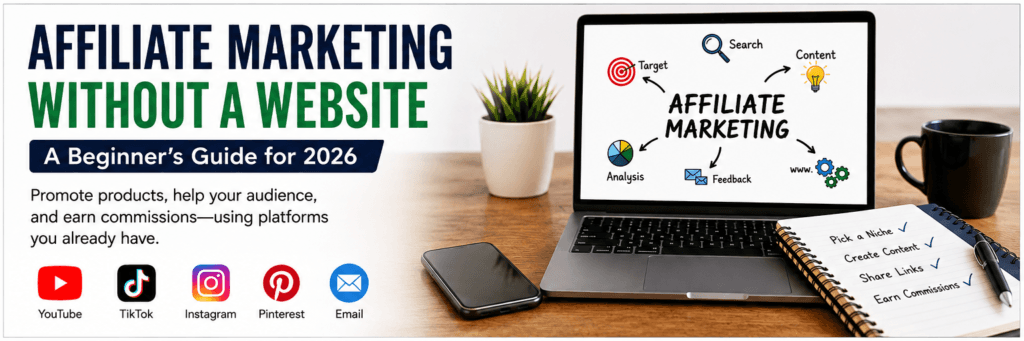
Want to start affiliate marketing but don’t have a website? You can still get started.
In 2026, you can build an affiliate marketing business without owning a traditional website. Depending on the affiliate program’s rules, you may be able to promote products through channels such as YouTube, TikTok, Instagram, Pinterest, or an opt-in email list.
The basic idea is simple: create useful content, recommend relevant products, share affiliate links where permitted, and earn a commission when qualifying purchases or actions happen through those links.
You don’t need to be everywhere at once. Start with one niche and one primary platform, learn what your audience responds to, and expand from there.
Affiliate Disclosure: This article contains affiliate links. If you join Wealthy Affiliate through one of my links, I may earn a commission at no additional cost to you. I may recommend products I have personally used as well as products or services I have researched and believe may provide value to readers. When I describe my personal experience with a product or service, that experience is my own. All opinions expressed are my own.
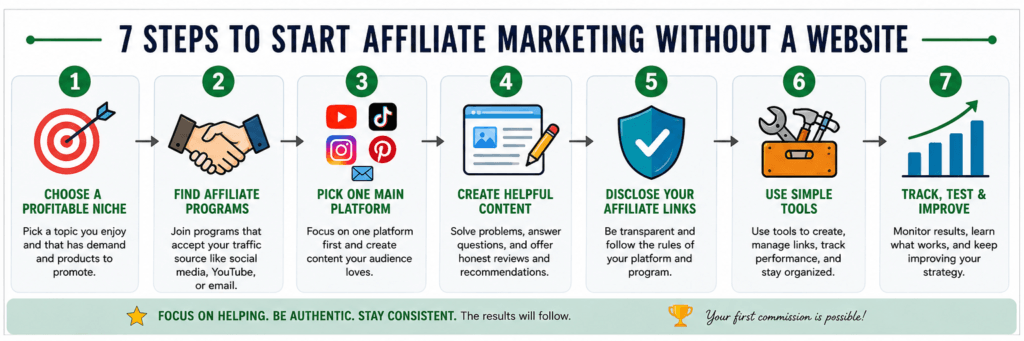
1. Choose a Profitable Niche
Don’t try to promote everything. Choose a specific topic with an audience that regularly searches for products, recommendations, or solutions.
Popular affiliate niches include:
- Technology and accessories
- Beauty and skincare
- Fitness
- Home and kitchen
- Gaming
- Pet products
- Travel
- Software and creator tools
Narrowing your focus can make it easier to create focused content and attract the right audience.
Instead of covering fitness, for example, you could focus on home workouts for busy professionals. Instead of general technology, you might cover budget gadgets for students.
Look for three things when choosing a niche:
- A topic you can consistently create content about
- An audience actively interested in the topic
- Products or services that genuinely help solve that audience’s problems
Your next move: Write down three niches you’re interested in. Choose the one where you can imagine creating at least 20 useful pieces of content.
2. Find Affiliate Programs That Accept Your Traffic Source
You don’t necessarily need a traditional website to join an affiliate program, but you should check each program’s current eligibility and promotional rules.
Potential options include:
- Amazon Associates
- Awin
- Impact
- ClickBank
- Direct affiliate programs offered by individual brands
Before applying, determine whether the program permits promotion through your chosen channel, such as YouTube, TikTok, Instagram, Pinterest, or email.
Requirements can vary considerably.
Some programs accept eligible social media channels, while others may require an established audience, specific content, or other qualifying properties. Approval is never guaranteed.
For example, Amazon Associates currently accepts certain social networks for applications, but says that social pages should be established and have a substantial number of organic followers or likes. Always verify the latest requirements directly with the affiliate program before applying.
When comparing programs, look beyond the commission percentage. Consider:
- Eligibility requirements
- Commission structure
- Cookie or attribution period
- Permitted traffic sources
- Payment requirements
- Product relevance
- Program reputation
Choose programs that make sense for both your platform and your audience.
3. Pick One Main Content Platform
Trying to grow five channels at once is an easy way to get overwhelmed.
Start with one primary platform and learn what works there.
YouTube
YouTube can work particularly well for:
- Product reviews
- Comparisons
- Demonstrations
- Tutorials
- Buyer guides
- Searchable evergreen content
TikTok and Instagram
Short-form platforms can be useful for:
- Quick product demonstrations
- Recommendations
- Tutorials
- Before-and-after examples
- Problem-solving content
- Short reviews and comparisons
Pinterest can be useful for visual and search-driven niches. Affiliate content is permitted, subject to Pinterest’s current policies, which include requirements around transparency, originality, value, and avoiding spammy behavior.
Always check the latest rules before publishing affiliate content.
An opt-in email list can eventually become another useful affiliate channel. However, email service providers and individual affiliate programs can impose their own restrictions on affiliate-focused messages and links.
Make sure your email marketing also complies with applicable marketing and privacy laws.
Focus first: Pick one primary platform and start publishing useful content before worrying about expanding to every available channel.
4. Create Content People Actually Need
Successful affiliate content shouldn’t feel like a constant stream of advertisements.
Help people solve a problem or make a better purchasing decision first.
Useful affiliate content formats include:
- Product reviews: “Is [Product] Worth It?”
- Comparisons: “[Product A] vs. [Product B]”
- Tutorials: “How to Use [Product]”
- Buyer guides: “Best Budget Microphones for Beginners”
- Problem-solving content: “3 Ways to Improve Your Home Office Setup”
- Short demonstrations: Show how a product solves a specific problem.
You don’t necessarily need millions of views.
A smaller piece of content that reaches people actively considering a purchase can sometimes generate more affiliate activity than a viral post viewed mainly by people with little buying intent.
Not Sure What to Publish First?
Search your chosen platform for questions people are already asking in your niche.
Look at:
- Search suggestions
- Comments
- Frequently asked questions
- Product reviews
- Common complaints
- Comparison searches
Then turn one of those questions into a useful video, post, Pin, or tutorial.
Instead of simply saying “Buy this product,” answer a real question such as:
- Is it worth the price?
- Who is this product best for?
- What are its limitations?
- How does it compare with an alternative?
- What problem does it solve?
Useful content gives people a reason to trust your recommendations.
5. Disclose Your Affiliate Relationship Clearly
Affiliate relationships should be disclosed clearly and prominently according to the laws, affiliate-program rules, and platform requirements that apply to you.
A simple disclosure might say:
“This post contains affiliate links. I may earn a commission if you purchase through them, at no additional cost to you.”
Place disclosures where people are likely to notice them rather than hiding them at the bottom of a page, behind a “more” button, or among unrelated hashtags.
For videos, include an appropriate disclosure in the video itself rather than relying only on the description. When appropriate, making the disclosure both visual and audible can make it easier for viewers to notice and understand.
Platform disclosure tools can also be useful, but don’t automatically assume that using a built-in tool satisfies every legal or affiliate-program requirement.
Before publishing affiliate content, check:
- Your affiliate program’s terms
- Your platform’s commercial-content rules
- Applicable disclosure requirements
- Whether additional branded-content tools or labels are required
Transparency isn’t just about compliance. It can also help establish trust with your audience.
6. Keep Your Affiliate Marketing Tools Simple
You don’t need an expensive setup to begin.
Depending on your platform and affiliate-program rules, useful tools may include:
Canva for graphics, thumbnails, Pins, and social content.
Link-in-bio tools to organize destinations from your social profiles, when permitted.
Google Sheets for tracking programs, content, clicks, conversions, and commissions.
Platform analytics for understanding views, engagement, audience behavior, and traffic.
Affiliate dashboards for monitoring clicks, conversions, commissions, and other program-specific metrics.
Be careful when changing affiliate URLs. Some affiliate programs and platforms have rules regarding redirects, link cloaking, or URL shorteners.
For example, Pinterest notes that some link-shortening services may not be supported.
The goal isn’t to build the most complicated marketing stack. Use only the tools you need to create, publish, track, and improve your content.
7. Track What Produces Sales—Not Just Views
Views and followers can tell you something about your reach, but affiliate marketing ultimately depends on actions.
A simple funnel to watch is:
Views → Link Clicks → Conversions → Commission
Imagine one video receives 100,000 views but produces very few affiliate-link clicks.
Another receives only 5,000 views but regularly generates clicks and purchases.
From an affiliate marketing perspective, the smaller video could be considerably more valuable.
Look for patterns in:
- Topics generating clicks
- Products generating conversions
- Content formats performing best
- Questions people repeatedly ask
- Videos or posts that continue producing traffic
- Content attracting visitors with strong buying intent
Then create more content around the topics and formats that produce meaningful results.
Set aside a few minutes each week to review your performance. Find your strongest content and identify another closely related question you can answer.
Can You Start Building an Affiliate Business With Zero Followers?
Yes.
You can start creating affiliate-focused content and building an audience from scratch, even if you don’t immediately qualify for every affiliate program.
Instead of creating a brand-new account and immediately filling it with affiliate links, focus first on useful content.
Publish:
- Tutorials
- Comparisons
- Answers to common questions
- Product demonstrations
- Educational content
- Thoughtful recommendations
This gives potential followers a reason to pay attention and gives affiliate programs something to review when you apply.
Some programs may require an established audience or other eligibility criteria, so don’t assume every application will be approved immediately.
Build the audience and content foundation while researching programs that match your stage of growth.
Your 30-Day Affiliate Marketing Challenge
You don’t need to spend months preparing before creating content.
Here’s a simple four-week plan.
Week 1: Choose Your Niche and Platform
Choose:
- One specific niche
- One target audience
- One primary content platform
Avoid spending the entire week designing logos, choosing fonts, or trying to perfect your branding.
Focus on what you’re going to help people with.
Week 2: Research Content and Affiliate Programs
Find at least 20 questions your target audience is asking.
At the same time, identify affiliate programs related to your niche and review:
- Eligibility requirements
- Permitted promotional channels
- Commission structures
- Attribution periods
- Program policies
This research helps you avoid building your strategy around a program you may not qualify for or a promotional method it doesn’t permit.
Week 3: Start Publishing
Turn your research into useful content.
You don’t need to publish all 20 ideas immediately.
Start consistently answering the questions most relevant to your audience and begin applying to appropriate affiliate programs when you meet their requirements.
Pay attention to which topics generate interest and engagement.
Week 4: Add Relevant Affiliate Recommendations
Once approved for suitable programs, add clearly disclosed affiliate recommendations where they naturally fit.
Don’t force a product into every piece of content.
Recommend something when it genuinely helps answer the question or solve the problem your content addresses.
Then start tracking your results.
Frequently Asked Questions
Do You Need a Website for Affiliate Marketing?
No. A traditional website isn’t always required.
Depending on the affiliate program, you may be able to use an eligible social media profile, creator channel, app, newsletter, or another approved online property.
However, every program sets its own requirements, so always check the current terms before applying.
Can You Put Affiliate Links Directly on Social Media?
Sometimes.
Whether you can place an affiliate link directly in a social post, profile, video description, Pin, or other location depends on both the platform’s policies and the affiliate program’s rules.
Never assume that because a platform technically allows a link, your affiliate program permits you to use it there.
Do You Need Thousands of Followers to Start?
No.
You can begin creating content with zero followers. However, some affiliate programs have audience, content, or traffic requirements before they approve an application.
Focus first on creating useful content and building a genuine audience.
How Long Does It Take to Make Your First Affiliate Commission?
There is no guaranteed timeline.
Results depend on factors such as your niche, audience, content quality, traffic, product selection, buying intent, conversion rates, and consistency.
Instead of focusing on how quickly you can earn your first commission, focus on creating content that helps the right people make informed decisions.
Ready to Start?
Don’t wait for a website, perfect branding, expensive equipment, or thousands of followers.
Start with three things:
Choose your niche. Pick your platform. Create your first useful piece of content.
If you already know your niche, take the next step:
→ Explore Recommended Affiliate Programs for Beginners
Still deciding what to promote?
→ See the Best Affiliate Marketing Niches for Beginners in 2026
Final Thoughts
You don’t need a traditional website to begin affiliate marketing in 2026.
What you do need is a way to reach an audience, useful content, suitable affiliate programs, transparent disclosures, and patience.
Start with one niche and one platform rather than trying to master everything at once.
Help people solve problems and make better decisions, not just push products. Pay attention to what generates clicks and conversions, improve your content based on those results, and expand once you’ve found an approach that works.
Your first commission isn’t guaranteed to happen overnight—but you can take the first step today.
Pick one useful idea and publish it.