


Choosing an affiliate marketing niche can feel surprisingly difficult when you’re starting out. There are thousands of products you could promote and seemingly endless topics you could build content around. It’s easy to spend weeks researching possibilities without actually publishing anything.
Affiliate Disclosure: This article may contain affiliate links. If you make a purchase through one of these links, I may earn a commission at no additional cost to you. I identify products I have personally used where relevant. I may also recommend products based on independent research, and I aim to explain the basis for each recommendation. All opinions are my own.
I know because I’ve done exactly that. I spent far too much time trying to find the “perfect” niche when I would have learned more by choosing a promising direction and testing it.
That doesn’t mean niche selection doesn’t matter. It does.
Your niche influences the products you can promote, the audience you attract, the competition you’ll face, and ultimately how you make money. But instead of chasing whichever market someone calls the most profitable this year, I prefer looking for the overlap between audience demand, monetization opportunities, and something I’m willing to keep learning about.
If you’re looking for the best affiliate marketing niches in 2026, this guide will help you evaluate your options and choose one based on more than hype.
What Is an Affiliate Marketing Niche?
An affiliate marketing niche is simply the specific market or topic you focus on when recommending products and services.
Instead of trying to promote everything, you might build your content around:
- AI productivity tools
- Home coffee equipment
- Gardening
- Photography
- Personal finance apps
- Running gear
- Pet products
- Golf equipment
You can narrow things down even further. Instead of “photography,” for example, you could focus on photography equipment for beginners. Instead of “fitness,” you might create content about home workouts for busy professionals.
Why Choose a Niche?
A focused niche gives you a clearer audience and makes it easier to create useful content around related problems and products.
It can also help you:
- Build topical authority over time
- Understand what your audience actually wants
- Find relevant products rather than promoting random offers
- Create interconnected reviews, comparisons, tutorials, and buying guides
- Develop trust by becoming known for a particular subject
Most importantly, choosing a niche gives your affiliate business some direction.
The goal isn’t necessarily to find a market nobody else has discovered. Competition often confirms that buyers and advertisers already exist. The better question is whether you can offer something useful or distinctive within that market.
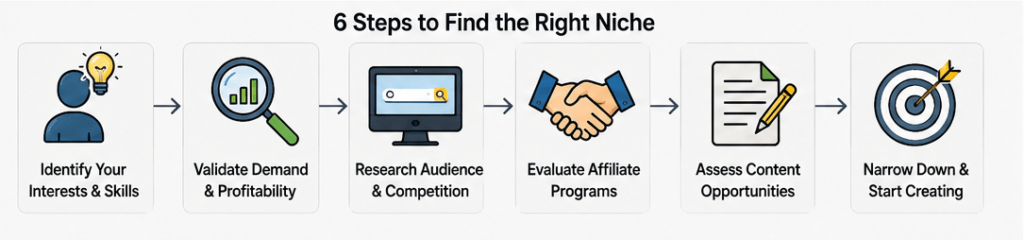
Step 1: Start With Your Interests, Skills, and Experience

Before looking at lists of affiliate marketing niche ideas, I like to start with a simple inventory of what I already know—or what I’m genuinely interested in learning.
Ask yourself:
- What hobbies do I spend time or money on?
- What professional skills do I have?
- What subjects do I naturally research?
- What problems have I learned how to solve?
- What do friends or coworkers ask me for advice about?
- Would I rather promote physical products, software, subscriptions, or courses?
You don’t need to be the world’s leading expert.
In fact, documenting what you’re learning can sometimes make your content more relatable to beginners. But you should ideally have enough interest in the subject to keep researching it after the initial excitement wears off.
For example, my brainstorm might look something like this:
Interests: photography, personal finance, houseplants
Preferred products: software and digital tools
Content I enjoy: tutorials, comparisons, and practical guides
That already gives me several directions to investigate.
Interest alone isn’t enough, though. The next step is figuring out whether people actually spend money in the market.
Step 2: Check Whether the Niche Can Make Money
A niche can attract plenty of attention without being particularly good for affiliate marketing.
What you’re looking for is commercial intent: Are people researching products, comparing options, and eventually buying something?
Here are a few things I check.
Look for Established Affiliate Programs
Search for companies in the niche and see whether they have affiliate or partner programs.
Large affiliate platforms such as impact.com give publishers access to brands across industries including retail, travel, beauty, fitness, technology, and financial services. Amazon Associates can also be useful for many physical-product niches, although commission rates vary considerably by product category.
For software and subscription-based niches, check individual companies as well. Some SaaS companies offer percentage-based or recurring commissions, although rates and terms vary widely from program to program.
Never choose a niche based on an advertised commission percentage alone. A smaller commission on a product that converts well can be worth considerably more than a huge commission on something nobody wants.
Look for Commercial-Intent Searches
Search terms such as:
- best [product]
- [product A] vs [product B]
- [product] review
- [product] alternatives
- best [product] for [specific audience]
- is [product] worth it?
If brands, publishers, and creators consistently produce content around these searches, that’s a useful indication that commercial demand exists.
Look for Multiple Ways to Monetize
I prefer niches where I’m not dependent on one affiliate program.
Ideally, there are several potential revenue sources: physical products, software, subscriptions, courses, services, sponsorships, or eventually your own products.
That diversification matters because affiliate programs can change their commissions, attribution rules, eligibility requirements, or even close entirely.
Affiliate Marketing Niches Worth Investigating in 2026
There’s no objective list of niches guaranteed to make money. Profitability depends on your audience, traffic quality, content, offers, conversion rates, and competition.
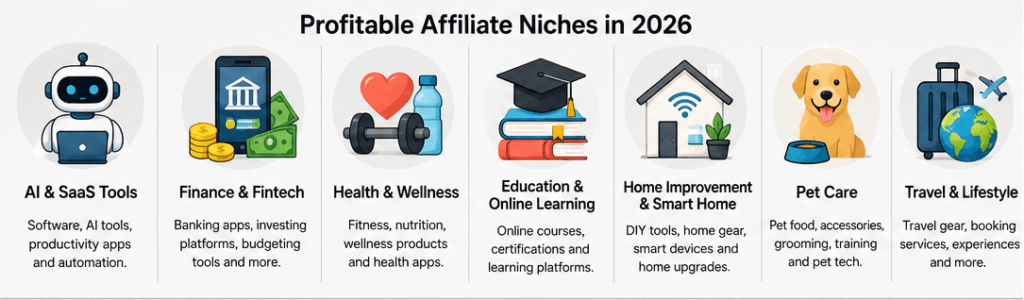
Still, several categories continue to have substantial commercial activity in 2026.
1. AI and SaaS Tools
AI and software remain particularly interesting for affiliate marketers because new tools continue to enter the market and many products use subscription pricing.
Possible micro-niches include:
- AI tools for small businesses
- AI writing and research tools
- Video and design software
- Productivity apps
- Automation tools
- SEO and marketing software
- Software for freelancers
- Industry-specific SaaS
The opportunity is real, but so is the competition. Generic articles listing dozens of AI tools are everywhere. Hands-on tutorials, original comparisons, workflow examples, and content aimed at a specific type of user have a better chance of being genuinely useful.
2. Personal Finance and Fintech
Financial apps, budgeting tools, accounting software, insurance, investing platforms, and other fintech products can offer strong commercial intent.
However, finance is also a high-trust subject. If you’re going into this niche, accuracy, transparency, firsthand expertise where applicable, and responsible claims matter far more than simply targeting high-paying keywords.
A narrower angle—such as bookkeeping tools for freelancers—may also be more manageable than trying to become a general personal finance publisher.
3. Health, Wellness, and Fitness
Health and wellness continues to be a huge consumer category, but it’s another area where trust and accuracy are critical.
Instead of making medical or exaggerated health claims, affiliate publishers can focus on areas such as:
- Fitness equipment
- Running gear
- Sleep products
- Wellness apps
- Outdoor fitness
- Home workout equipment
Be especially careful when discussing medical conditions, supplements, treatments, or anything else that could affect someone’s health decisions.
4. Education and Career Development
People continue to spend money on acquiring skills and advancing their careers.
Affiliate opportunities can include:
- Online courses
- Language-learning platforms
- Professional certifications
- Study tools
- Coding education
- Career software
- Productivity platforms
This niche works particularly well when you can demonstrate how a tool or course is actually used instead of simply describing its sales page.
5. Home Improvement and Smart Home Products
Home improvement offers a huge range of potential products, from inexpensive tools to high-ticket equipment and smart-home technology.
You could specialize in:
- DIY tools
- Small-space improvement
- Home offices
- Smart-home devices
- Energy-saving products
- Gardening equipment
- Home organization
This is also a naturally visual niche, making it suitable for blogs, YouTube, Pinterest, Instagram, and short-form video.
6. Pet Care
Pet owners regularly buy food, accessories, grooming products, toys, training products, and technology for their animals.
Rather than building another general pet website, consider narrowing your audience.
For example:
- Products for senior dogs
- Indoor-cat enrichment
- Dog travel gear
- Pet technology
- Products for new puppy owners
A specific audience gives you clearer problems to solve and products to recommend.
These aren’t the only profitable affiliate niches in 2026. Travel, beauty, consumer technology, creator tools, hobbies, and specialized B2B markets can also work. The important part is validating the specific opportunity rather than assuming an entire industry is profitable for everyone.
Step 3: Research Audience Demand
Once I have a niche idea that appears monetizable, I want to know whether people consistently care about it.
Check Search Trends
Google Trends can help you compare relative search interest over time and see whether a subject is rising, falling, seasonal, or relatively stable. Its figures are sampled and normalized rather than exact search-volume totals, so use them as directional evidence rather than a precise measure of demand.
Keyword research platforms can provide estimated search volumes and competition data as well. Treat those numbers as estimates rather than exact measurements.
I also look beyond raw search volume.
A keyword with 500 highly motivated searchers can sometimes be more valuable than a broad informational keyword attracting 10,000 visitors who have no intention of buying anything.
Study the Competition
Competition isn’t automatically bad.
If established websites, YouTube channels, newsletters, and creators are succeeding in a niche, that can be evidence of a functioning market.
I ask:
- What topics are competitors covering?
- What questions aren’t they answering well?
- Are their reviews based on actual experience?
- Is their content outdated?
- Could I target a more specific audience?
- Can I explain the topic more clearly?
Sometimes a crowded market contains surprisingly weak content.
Listen to Real Conversations
Reddit, YouTube comments, niche communities, forums, and social platforms are great places to discover the language people actually use.
Pay attention to questions such as:
“What should I buy?”
“Is this worth the money?”
“What’s a cheaper alternative?”
“Does this work for beginners?”
Those questions can become future articles, videos, emails, and product comparisons.
Step 4: Evaluate Affiliate Programs Carefully
Finding an affiliate program doesn’t automatically make a niche attractive.
I look at the complete offer.
Things Worth Checking
Commission structure: Is it a fixed amount or percentage of the sale? Is it one-time or recurring?
Attribution window: How long after a referral can a qualifying purchase potentially earn you a commission?
Product price: A 5% commission on a $1,000 product is very different from 5% on a $10 product.
Conversion potential: Does the product have a good reputation, clear value proposition, and reasonable price?
Refunds and cancellations: These can affect your final earnings.
Program reputation: Does the merchant have clear terms and reliable tracking and payments?
Audience fit: Most importantly, would you recommend the product even if the commission weren’t unusually high?
Geographic and channel restrictions: Is the program available in your country, and does it permit promotion through your website, newsletter, social account, or other chosen channel?
Don’t assume that the program with the longest attribution window or highest commission is automatically best. Attribution models and program terms differ, and conversion rate often matters more.
Step 5: Make Sure You Can Actually Create Content
This is one of the most overlooked parts of niche selection.
You might discover an incredibly profitable-looking niche and then realize you have no idea what to publish after your first five articles.
As a practical test before committing, try brainstorming 20 to 30 realistic content ideas. This isn’t a magic threshold; the point is to confirm that the niche offers enough useful subjects to support ongoing work.
Look for opportunities to create:
- Product reviews
- Product comparisons
- Buying guides
- Tutorials
- Beginner guides
- Troubleshooting content
- Case studies
- Alternatives posts
- Videos and demonstrations
- Email content
I also like niches that combine evergreen questions with new products and developments. That gives you a stable foundation without forcing you to chase trends every day.
Step 6: Find Your Micro-Niche
One of the easiest ways to make a competitive niche more approachable is to get more specific.
Instead of:
Fitness
Try:
Home fitness for busy parents
Instead of:
AI tools
Try:
AI tools for real estate agents
Instead of:
Gardening
Try:
Balcony gardening for apartment dwellers
A useful formula is:
Broad market + specific audience + specific problem
You can always expand later. Starting narrow simply makes it easier to understand who you’re creating content for.
Common Affiliate Niche Mistakes
I’ve made some of these myself, and they’re surprisingly easy to fall into.
Choosing a niche only because commissions look high. A 50% commission means nothing if you can’t attract the right audience or convince anyone to buy.
Picking something you don’t want to learn about. Affiliate sites take time. If you’re already bored after five articles, maintaining the project will be difficult.
Going too broad. Competing for “fitness” or “technology” is very different from serving one specific group within those markets.
Ignoring the products. Traffic doesn’t automatically become revenue. Make sure there are products worth recommending before building an entire content strategy.
Waiting for the perfect niche. Research is useful until it becomes procrastination.
At some point, you have to publish something and see what happens.
FAQs About Affiliate Marketing Niches
Which affiliate marketing niches are worth exploring in 2026?
There isn’t one universally “best” niche. Areas worth investigating in 2026 include AI and SaaS tools, personal finance and fintech, health and wellness, education, technology, home improvement, pet care, travel, and creator-focused tools. Treat this as a research shortlist rather than a profitability ranking.
The better approach is to find a micro-niche within one of these larger markets where you have enough audience demand, suitable affiliate programs, and room to create genuinely useful content.
What makes an affiliate niche profitable?
A strong affiliate niche usually combines several things:
- An identifiable audience
- Problems people spend money to solve
- Products or services worth recommending
- Multiple affiliate programs
- Commercial search intent
- Enough content opportunities to grow
- A realistic way for you to compete
High commissions alone don’t make a niche profitable.
Should beginners choose a broad or narrow niche?
I generally prefer starting narrower.
“Fitness” could become “strength training for women over 40.” “Technology” could become “smart-home technology for renters.”
A specific audience makes content planning easier and gives visitors a clearer reason to follow you. You can expand into related subjects once you understand what’s working.
Can I start affiliate marketing without a website?
Yes. A website is only one distribution channel.
Depending on the affiliate program’s rules, creators can use channels such as YouTube, social media, newsletters, podcasts, or other approved publishing platforms.
Before posting affiliate links anywhere, check both the affiliate program’s current terms and the platform’s rules. Program availability, commission rates, attribution rules, and permitted promotional channels can vary by country and change over time.
You should also clearly and conspicuously disclose affiliate relationships close to the relevant recommendation or link. Transparency isn’t just good practice—it helps your audience understand when you may earn money from a recommendation.
Should I choose a niche with low competition?
Not necessarily.
Extremely low competition can sometimes mean there’s little commercial demand.
Instead of looking for a niche with no competition, I look for a market with proven demand where I can compete differently—through better firsthand experience, a narrower audience, more useful comparisons, original testing, stronger explanations, or a format competitors haven’t covered well.
A Simple Game Plan for Choosing Your Affiliate Niche
If you’re still stuck between several affiliate marketing niche ideas, don’t spend another month trying to predict the perfect choice.
Run a small test.
- Brainstorm five niches based on your interests, experience, and problems you understand.
- Check whether each niche has real products and active affiliate programs.
- Research search demand, competitors, communities, and buying intent.
- Narrow the list to two or three promising options.
- Brainstorm 20 content ideas for each.
- Create a few pieces of content and see which topic you actually enjoy working on.
- Pay attention to impressions, clicks, engagement, email signups, and eventually conversions.
- Commit to the niche showing the best combination of opportunity and personal fit.
Your first niche doesn’t have to become your niche forever.

That’s something I wish I’d understood earlier. You can do all the keyword research and competitor analysis in the world, but you learn different things once you start publishing.
Choose something with real demand and monetization potential, make it specific enough that you know exactly who you’re helping, and start creating.
You can refine the niche as the data comes in.
The goal isn’t to predict the perfect affiliate business before you’ve published your first piece of content. It’s to choose a promising direction, learn what your audience responds to, and get better from there.
Ready to Find Your Profitable Affiliate Niche?
You don’t need to find the perfect niche before you start. You just need one with real audience demand, products worth recommending, and enough potential to keep you interested as you build.
Pick one of your best affiliate marketing niche ideas, validate the demand, and create your first piece of content. The sooner you start testing, the sooner you’ll discover what actually works for you.
Ready to take the next step?
👉 Read my step-by-step guide on How to Start in Affiliate Niche Marketing and turn your niche idea into an affiliate business.