

Affiliate marketing is a relatively accessible way to begin monetizing a blog, website, newsletter, YouTube channel, or social media audience. However, generating meaningful income usually requires sustained content, relevant traffic, and audience trust.
Affiliate disclosure: This article contains affiliate links. If you purchase through one of these links, I may earn a commission at no additional cost to you. Compensation does not determine which programs are included or what I say about them.
For beginners, software and business tools can be particularly interesting because many operate on subscriptions. Some software-as-a-service (SaaS) affiliate programs therefore pay commissions for several months rather than rewarding only the initial purchase.
In this guide, you’ll learn how affiliate marketing works, what to look for in a program, which SaaS-focused networks and programs are worth exploring, which tools can help, and how to start building an affiliate strategy in 2026.
The networks and programs below are researched examples, not a definitive ranking. I selected them for their relevance to common beginner niches, the availability or status of an official partner program, and their usefulness to particular audiences. Inclusion does not mean I have personally used every service. Where I lack firsthand experience, I present the information as research rather than product testing.
Program details last verified: August 19, 2026. Commission rates, attribution windows, eligibility requirements, application availability, and promotional rules can change. Confirm each provider’s current terms before applying or publishing a recommendation.
What Is Affiliate Marketing?
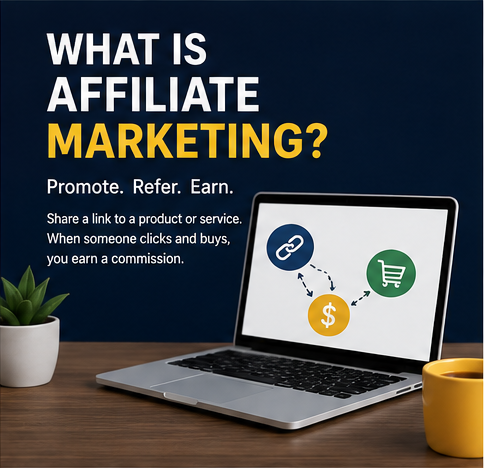
Affiliate marketing is a performance-based marketing model where you recommend another company’s product or service through a unique tracking link.
The process usually works like this:
- You join an affiliate program or network.
- You receive a unique affiliate link.
- You create useful content that includes your recommendation.
- A visitor clicks your link.
- If the visitor completes a qualifying purchase or action, you may earn a commission.
Affiliate links can appear naturally in tutorials, product reviews, comparisons, resource pages, newsletters, videos, and social media content—as long as the program and platform allow that type of promotion.
The goal shouldn’t be to publish as many links as possible. Sustainable affiliate marketing starts with recommending products that genuinely solve your audience’s problems.
Affiliate Networks Worth Exploring
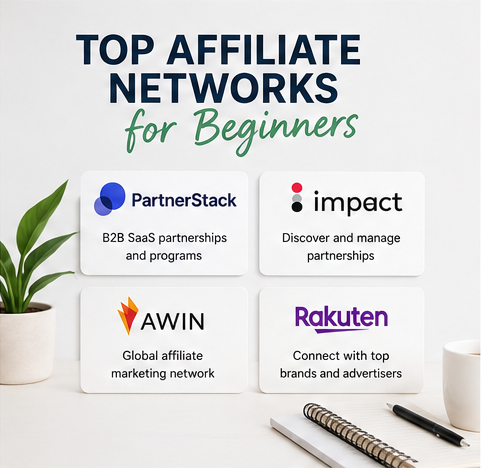
An affiliate network gives publishers access to multiple brands or partner programs from one platform. Joining a network does not automatically approve you for every advertiser on it.
1. PartnerStack
PartnerStack specializes in B2B SaaS partnerships, making it particularly relevant if your content covers software, marketing, productivity, or online business.
Because many SaaS businesses use subscription pricing, some PartnerStack programs offer recurring or extended commission structures. The terms and approval criteria are set by each program.
2. impact.com
impact.com works with brands across numerous industries and provides partners with tools to find programs, create tracking links, and monitor performance.
Program approval and commission terms vary by advertiser, so don’t assume that joining the platform gives you access to every brand.
3. Awin
Awin is an established affiliate marketing platform with advertisers spanning numerous consumer and business categories.
Awin completed the migration of active ShareASale customers and ended access to the ShareASale platform on October 6, 2025. In 2026, prospective publishers should research and apply through Awin. See Awin’s official ShareASale migration announcement.
4. Rakuten Advertising
Rakuten Advertising connects publishers with established advertisers across numerous categories.
As with other networks, individual advertisers determine their approval criteria, commission structures, attribution periods, and promotional rules.
How to Choose the Best Affiliate Program
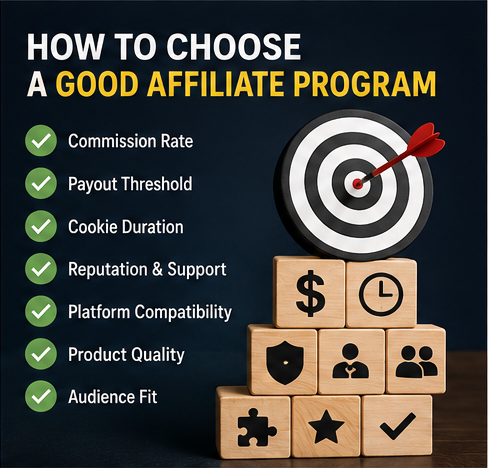
A high commission percentage doesn’t automatically make a program a good choice. Before applying, evaluate the following factors.
Commission Structure
Find out exactly how affiliates are paid. A program might offer:
- A percentage of each sale
- A fixed payment per conversion
- Recurring commissions
- Tiered commissions based on performance
For subscription software, recurring or extended commissions can be attractive—but only if the product is genuinely useful to your audience.
Attribution Window
The cookie or attribution window determines how long your referral can potentially be credited after someone clicks your link.
A longer window can be helpful when customers typically take time to make a purchase. Read the full attribution rules, however, because another referral, a coupon, a different device, or browser settings may affect credit.
Payout Requirements
Check:
- Minimum payout amount
- Payment schedule
- Supported payment methods
- Holding or refund periods
- Currency and international payment restrictions
- Tax documentation requirements
Affiliate income may be taxable. Keep accurate records and consult the relevant tax authority or a qualified professional about the rules that apply to you.
Product Quality
Don’t choose a product solely because it offers a large commission. Ask yourself:
Would I still recommend this product if I weren’t being paid?
If the answer is no, it probably shouldn’t appear in your content.
Audience Fit and Eligibility
A smaller commission from a product your readers actually need can outperform a large commission from an irrelevant product.
Match the offer to the problem your reader is trying to solve. Also check whether the program requires an established website, minimum traffic, a particular audience, original content, or approved promotional channels. You do not necessarily need a large audience, but acceptance is never guaranteed.
Promotional Rules
Read the program’s terms before publishing links. Some programs restrict:
- Paid search advertising
- Coupon websites
- Email marketing
- Certain social networks
- Brand-name bidding
- Direct linking from advertisements
- Link cloaking or redirects
Following the rules protects both your commissions and your account.
SaaS Affiliate Programs Beginners Can Research
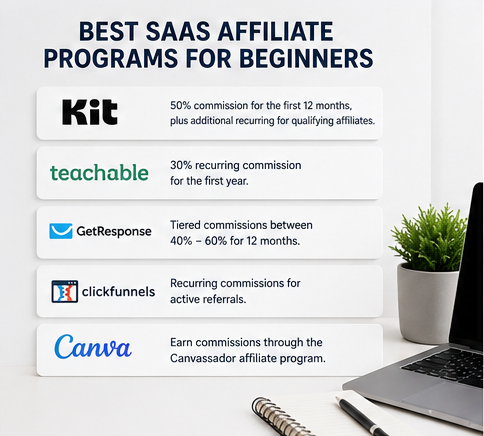
If your audience consists of creators, freelancers, marketers, or small business owners, SaaS programs can be a natural fit.
| Program | Best suited to | Advertised commission | Attribution window | Application status* |
|---|---|---|---|---|
| Kit | Creators and newsletter publishers | 50% for the first 12 months; qualifying status levels may add 10–20% thereafter | Confirm in current terms | Open to applications |
| Teachable | Course creators and educators | 30% recurring for the first year | 30 days | Open to applications |
| GetResponse | Email marketers and small businesses | 40% for 12 months; 50% and 60% volume tiers | 90 days | Open to applications |
| ClickFunnels | Funnel builders and digital marketers | 30% recurring for the life of a referred paying customer | Confirm in current terms | Subject to approval |
| Canva | Design educators and tutorial creators | Details provided to accepted Canvassadors | Not publicly specified | Closed to new applications |
Status and terms were checked August 19, 2026 and can change.
Kit
Kit, formerly Convert Kit, is an email marketing platform aimed at creators.
Its official affiliate page advertises a 50% commission on referred customers’ payments during their first 12 months. Affiliates who reach and retain qualifying Bronze, Silver, or Gold status may earn an additional 10–20% recurring commission after the first year, subject to Kit’s current rules.
Kit may be relevant for content about email list building, newsletters, creator businesses, landing pages, and email automation.
Teachable
Teachable is a platform for creating and selling online courses and other digital products.
Its official partner page advertises a 30% recurring commission for the first year on qualifying referrals, with a 30-day attribution window.
It can fit naturally into content about creating courses, selling expertise online, or launching digital products.
GetResponse
GetResponse provides email marketing, automation, and related marketing tools.
Its official affiliate page starts affiliates at 40% commission for 12 months. It advertises a 50% tier after 50 sales in a 12-month period and a 60% tier after 100 sales in that period, along with a 90-day referral cookie. Eligibility and potential earnings depend on current program terms.
It may fit audiences interested in email marketing, lead generation, automation, and online business.
ClickFunnels
ClickFunnels provides sales funnel and online marketing tools. Its official program material advertises a 30% recurring commission for the life of a referred paying customer, subject to approval and current program terms.
Consider whether your audience genuinely needs funnel-building software, and verify the commission and attribution terms for the specific offer before promoting it.
Canva: Currently Closed to New Applicants
Canva is widely used for graphics, presentations, social media content, and marketing materials.
Canva says affiliate benefits are available only through its community-based Canvassador program. As of August 2026, the program is closed to new applications. Check Canva’s official help page for reopening announcements rather than relying on older affiliate information. Existing affiliates may be subject to separate transition requirements.
Useful Affiliate Marketing Tools for Beginners
You don’t need a complicated tech stack to get started. The following tool categories can make creating and managing affiliate content easier.
Link Management: Pretty Links or ThirstyAffiliates
WordPress users can use Pretty Links or ThirstyAffiliates to organize affiliate URLs and create cleaner internal redirect links where permitted.
Always confirm that redirects or link cloaking comply with the relevant program’s terms. A cleaner URL does not remove the need for a clear affiliate disclosure.
Program Dashboards and Analytics
Beginners can usually start with the dashboards that their affiliate programs and networks provide. Track clicks, conversions, reversals, commissions, and payouts in a simple spreadsheet.
Consolidated reporting software may become useful after you join multiple networks, but it adds cost and complexity. Choose it only when manual reporting becomes inefficient, and review how it handles account credentials and business data before connecting your accounts.
Visual Content: Canva or Similar Design Software
Visual content can make tutorials, social posts, comparison graphics, and downloadable resources easier to understand. You can still use Canva as a design tool, even though its affiliate applications are currently closed.
Writing and Editing Tools
Grammar and writing assistants can help polish articles, emails, and product comparisons. Use them to improve your writing—not to manufacture product experiences you haven’t actually had.
How to Start Affiliate Marketing: 7 Steps
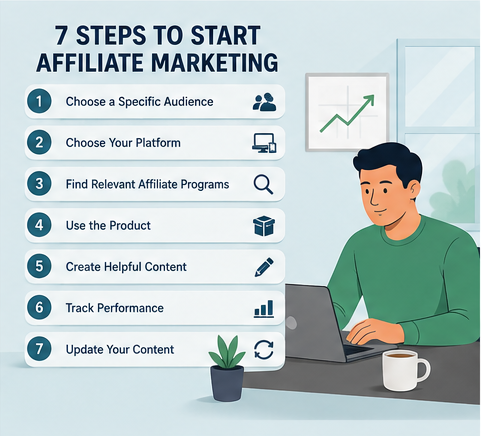
1. Choose a Specific Audience
Instead of targeting everyone interested in “business,” narrow your focus. Examples include:
- Software for freelancers
- Tools for new bloggers
- Marketing software for small businesses
- Productivity apps for remote teams
- Creator tools for beginners
Specific audiences make it easier to create useful recommendations.
2. Choose Your Main Content Platform
You might start with a blog, YouTube channel, newsletter, TikTok or Instagram account, or a focused online community.
Choose the platform where you can consistently publish useful content. Review both the platform’s policies and the affiliate program’s rules before posting links.
3. Find Relevant Affiliate Programs
Research networks and direct affiliate programs that match your niche.
Before joining, review the commission structure, attribution window, payment and tax documentation rules, promotional restrictions, application requirements, product reputation, and current availability.
4. Use the Product Before Making Experience-Based Claims
Firsthand experience makes reviews and tutorials significantly more useful. If you have not used a product, describe your content as research or a feature overview—not a hands-on review.
Do not claim a personal experience you did not have. Show readers what the tool does, where it performs well, and where it falls short, and clearly state the basis for each observation.
5. Create Search-Friendly Content
Useful, purchase-oriented content answers questions people research before deciding. Examples include:
- [Product] Review: Is It Worth It?
- [Product A] vs. [Product B]: Which Is Better for Beginners?
- Best [Type of Software] for Small Businesses
- How to Use [Product]: Beginner Tutorial
- Best Free and Paid Tools for [Specific Problem]
Focus on solving the reader’s problem first. Include original evidence where possible, such as screenshots, test results, worked examples, pricing checks, or clearly labeled firsthand observations. The affiliate link should support the content, not dominate it.
6. Track Performance Responsibly
Monitor metrics such as:
- Affiliate-link clicks
- Conversion rate
- Revenue
- Earnings per click
- Reversals or refunds
- High-converting pages
- Traffic sources
If your site uses cookies, pixels, analytics, or other tracking technologies, provide appropriate privacy information and consent controls where required. Avoid collecting more personal data than you need.
7. Update Your Content
Affiliate programs change. Companies can adjust commission rates, attribution periods, pricing, features, affiliate terms, and program availability.
Review your most important affiliate pages regularly so readers aren’t making decisions based on outdated information. Displaying a “last checked” date makes the review process more transparent.
Affiliate Content Ideas That Can Attract Buyers

Affiliate Content Ideas That Can Attract Buyers
Beginner Tutorials
Create step-by-step tutorials that solve a specific problem using the product.
Product Comparisons
Compare competing products using meaningful criteria such as price, ease of use, features, support, and the ideal user. Don’t declare one product the winner just because it pays a higher commission.
Case Studies
If you’ve genuinely used a tool, document what happened. Show the process, results, limitations, and lessons learned. Clearly explain whether the product was purchased, supplied for free, or accessed through another commercial relationship.
Resource Pages
Create a curated page containing the tools you actually recommend. Briefly explain who each tool is best for, rather than publishing a page full of unexplained affiliate links.
Templates and Checklists
Useful downloadable resources can complement tutorials, build your email list, and help readers apply what they’ve learned. If you collect email addresses, explain what subscribers are signing up to receive and follow the applicable email and privacy rules.
Frequently Asked Questions
Do You Need a Large Audience for Affiliate Marketing?
Not necessarily. Audience relevance can matter more than raw audience size. A small group of readers actively searching for a particular solution may be more valuable than a much larger audience with little purchasing intent.
Some programs nevertheless evaluate your website, traffic, content quality, audience alignment, or promotional channels before approving an application. Affiliate marketing doesn’t guarantee income, and building meaningful traffic, trust, and conversions usually takes consistent work.
Can Beginners Join Multiple Affiliate Networks?
Yes, assuming the networks accept your applications and their terms permit your promotional methods.
Starting with a small number of highly relevant programs can be easier than trying to manage dozens at once.
Are High-Commission Affiliate Programs Better?
Not necessarily. Consider conversion potential, product quality, customer retention, refund rates, audience fit, program reliability, and promotional restrictions alongside the headline commission.
Do Affiliate Links Need to Be Disclosed?
Yes. Disclose affiliate relationships clearly and conspicuously, close to the recommendation or affiliate link. The precise legal requirements depend on your location, audience, and platform.
For content directed to U.S. consumers, the Federal Trade Commission’s disclosure guidance says people should be able to notice and understand the disclosure easily. A disclosure hidden in a footer, profile, or separate policy page may not be sufficient.
For videos, include the disclosure in the video, not just in the description. For social posts, disclose the relationship in the post itself. Platform disclosure tools can supplement—but may not replace—your own clear disclosure.
Final Thoughts: Start With Trust, Not Commissions
The best affiliate program for a beginner isn’t necessarily the one offering the biggest commission. It is the program that combines a useful product, reliable tracking, reasonable terms, current availability, and a strong match with your audience.
Start with a focused niche. Choose a few products you understand. Create tutorials, comparisons, reviews, and resources that genuinely help people make better decisions. Then use your performance data to decide what deserves more attention.
Affiliate marketing is a long-term content strategy—not a guaranteed shortcut to passive income.
Ready to Start?
Choose one problem your audience needs help solving and one product you would genuinely recommend to solve it.
Then create your first helpful tutorial, review, or comparison around that problem. Visit the official program page, confirm the current terms and availability, and compare the product’s usefulness, eligibility rules, attribution window, commission structure, payment terms, and promotional restrictions before applying or publishing.