

AI has become one of the most useful additions to an affiliate marketer’s toolkit—but having more AI tools doesn’t automatically make your affiliate business better.
The real advantage comes from knowing where AI can save time without replacing the research, judgment, experience, and personality that make your content useful.
In 2026, affiliate marketers can use AI to brainstorm topics, research competitors, improve SEO, create graphics, draft content, analyze data, manage email campaigns, and produce advertising variations.
But there is an important distinction: AI should assist your marketing—not become your marketing.
If you’re looking for the best AI tools for affiliate marketers in 2026, this guide covers eight options worth considering, what each does best, and how to build a practical AI stack without paying for software you don’t need.
Affiliate Disclosure: This article contains affiliate links. If you join Wealthy Affiliate through one of my links, I may earn a commission at no additional cost to you. I recommend only products and services I have personally used or genuinely believe will add value for my readers. All opinions expressed in this review are my own.
Why AI Tools Matter for Affiliate Marketers
Affiliate marketing involves much more than inserting links into articles.
You may need to:
- Research niches and products
- Find keywords and content opportunities
- Analyze competitors
- Write and update articles
- Create images and social content
- Build email campaigns
- Track performance
- Test advertising ideas
Doing all of this manually can consume a lot of time.
AI can speed up many of these tasks. For example, it can turn rough notes into an outline, summarize research, generate keyword variations, suggest email subject lines, create graphics, or help compare information from several sources.
That doesn’t mean you should publish whatever an AI tool generates.
Google’s guidance says generative AI can help with research and add structure to original content. However, generating large amounts of content without adding value for users can violate Google’s spam policies.
For affiliate marketers, that’s an important distinction.
The goal isn’t to publish more AI content.
The goal is to use AI to create better, more useful content more efficiently.
Best AI Tools for Affiliate Marketers in 2026
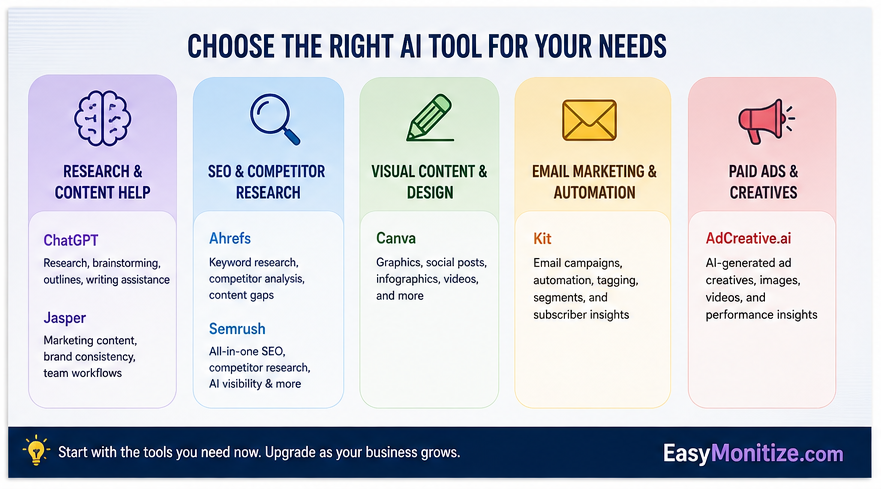
No single AI tool is best for every affiliate marketer. Your ideal setup depends on whether you concentrate on blogging, SEO, social media, email marketing, paid advertising, or a combination.
Here are eight tools worth considering.
1. ChatGPT — Best for Research, Brainstorming and Content Assistance
Best for: Research assistance, outlines, editing, brainstorming, and workflow support
ChatGPT is one of the most versatile AI tools an affiliate marketer can add to a workflow.
You can use it to:
- Brainstorm article ideas
- Develop content outlines
- Compare research
- Rewrite confusing sections
- Generate FAQ ideas
- Analyze uploaded information
- Create social-media concepts
- Draft email copy
- Identify gaps in an article
- Turn research into structured notes
Current ChatGPT capabilities can also support web research and source-backed analysis, depending on your account features.
That makes it particularly useful before and during the writing process.
However, don’t treat an AI-generated answer as automatically correct. Check product specifications, prices, affiliate commissions, program terms, and other changing informationagainst reliable, current sources before publication.
Best practice: Use ChatGPT to accelerate research and writing—not to invent personal product experience.
2. Jasper — Best for Marketing Teams and Brand Consistency
Best for: Marketing content and maintaining consistent brand messaging
Jasper is positioned more specifically toward marketing workflows.
Its features can help businesses create content while maintaining defined brand voices, audiences, and knowledge assets. This can be particularly useful if you’re operating multiple affiliate sites or working with several writers.
Jasper may be useful for:
- Marketing campaigns
- Content creation
- Brand-consistent messaging
- Campaign workflows
- Repurposing content
- Team-based content production
Jasper isn’t necessarily the first tool I’d recommend to a beginner with a limited budget.
As of this article’s 2026 review, Jasper’s Pro plan is paid, though the company offers a limited free trial. Pricing and trial terms can change, so check the current offer before subscribing.
For a solo affiliate marketer, the question is whether Jasper’s marketing-focused workflow provides enough additional value to justify another subscription.
3. Surfer — Best for SEO Content Optimization
Best for: Optimizing articles for search visibility
Surfer is useful for marketers who publish a significant amount of search-focused content.
Its Content Editor provides real-time guidelines and scoring for SEO- and GEO-focused content, while Surfer also offers AI-assisted content tools.
You can use it to evaluate areas such as:
- Topic coverage
- Relevant terms
- Content structure
- Optimization opportunities
- Existing content
- Search-focused content briefs
The important word here is guidance.
A content score doesn’t guarantee a top Google ranking, and blindly adding every suggested keyword can make an article worse.
Use optimization tools to identify potential gaps, then make editorial decisions based on what genuinely helps readers.
4. Ahrefs — Best for Keyword and Competitor Research
Best for: SEO research backed by search data
AI becomes much more useful for keyword research when it’s combined with actual search data.
That’s where platforms such as Ahrefs have an advantage over simply asking a general-purpose chatbot for “profitable keywords.”
Ahrefs currently incorporates AI features that can help with tasks including:
- Generating keyword ideas
- Understanding search intent
- Finding content opportunities
- Analyzing competitors
- Identifying content gaps
- Assisting with content optimization
For affiliate marketers building sites around organic traffic, this combination of AI and SEO data can be particularly useful.
One caution: don’t assume a keyword is profitable just because an AI system suggests it.
Consider search intent, competition, relevance to your audience, commercial potential and whether you can create something genuinely better than what’s already available.
5. Semrush — Best for All-in-One SEO and Competitive Research
Best for: Marketers who want SEO, competitor and AI-visibility tools in one platform
Semrush is another established SEO platform that has expanded its AI capabilities.
Its current toolset covers areas including:
- Keyword research
- Competitor research
- Content optimization
- Site auditing
- Rank tracking
- AI visibility
- Prompt research
- Backlink analysis
For an affiliate marketer, the biggest benefit is having multiple research tools within a single ecosystem.
That can also be its downside.
If you’re just getting started, you may not need such a large toolkit. Learn which metrics actually influence your decisions before paying for features you rarely use.
6. Canva — Best for Affiliate Graphics and Social Content
Best for: Blog graphics, Pinterest images, social media, and visual content
Affiliate marketing isn’t limited to written articles.
Pinterest pins, Instagram graphics, featured images, charts, comparison graphics, and other visual content can all support your marketing strategy.
Canva combines its established design platform with an expanding set of AI-assisted creation features.
Affiliate marketers can use Canva for:
- Featured blog images
- Pinterest pins
- Social-media posts
- Infographics
- Comparison graphics
- Short-form video assets
- Presentations and promotional materials
In 2026, Canva has continued expanding its AI capabilities, including conversational and AI-assisted creative workflows.
One important correction from older recommendations: Canva Free and Canva Pro are different offerings. You don’t need Pro to start designing, so begin with the features you actually need before upgrading.
7. Kit — Best for Email Marketing and Audience Management
Best for: Affiliate marketers building an email audience
If you’ve seen older articles referring to ConvertKit, the company is now called Kit.
Kit remains focused on creators and email-based businesses, and its capabilities extend beyond simply sending newsletters.
In 2026, Kit introduced Subscriber Signals, which can combine subscriber information with engagement data to help eligible users identify potentially influential or high-intent subscribers and build more useful segments.
Affiliate marketers can use an email platform like Kit to:
- Collect subscribers
- Create email sequences
- Tag and segment audiences
- Deliver lead magnets
- Build automated email journeys
- Send newsletters
- Promote relevant content and offers
AI and automation can make email management more efficient, but personalization still matters.
Avoid treating every subscriber as an opportunity to send another affiliate promotion. Useful emails build trust first.
8. AdCreative.ai — Best for Paid Ad Creative
Best for: Marketers testing multiple advertising concepts
If paid advertising is part of your affiliate strategy—and your affiliate program allows it—AdCreative.ai can help produce advertising variations.
Its platform includes tools to generate ad creatives and evaluate creative concepts.
That can help when you need several variations for testing, rather than manually designing every advertisement from scratch.
But AI-generated creative doesn’t remove the risks associated with paid affiliate traffic.
Before running a campaign, verify:
- Your affiliate program permits paid advertising
- Your claims are accurate
- Your landing page complies with applicable rules
- Required disclosures are present
- Your ad platform permits the promotion
- You’re not bidding on prohibited brand terms
An attractive AI-generated ad isn’t useful if it violates your affiliate agreement.
Quick Comparison: Best AI Tools for Affiliate Marketing
| Tool | Best Use | Best For |
|---|---|---|
| ChatGPT | Research and content assistance | Beginners and experienced marketers |
| Jasper | Marketing content and brand consistency | Teams and multi-brand publishers |
| Surfer | Content optimization | SEO-focused bloggers |
| Ahrefs | Keyword and competitor research | Organic-search affiliates |
| Semrush | SEO and competitive analysis | Growing affiliate businesses |
| Canva | Graphics and social content | Bloggers and social marketers |
| Kit | Email marketing | Audience-focused affiliates |
| AdCreative.ai | Advertising creatives | Paid-traffic marketers |
EasyMonitize Tip: Don’t subscribe to all eight. Pick the tools that solve problems you actually have.
How to Choose the Right AI Tools
Before paying for another AI subscription, ask yourself one question:
What problem am I trying to solve?
If writing takes too long, a writing and research assistant might help.
If you’re struggling to find search opportunities, consider an SEO research platform.
If your articles lack strong visuals, Canva may be enough.
If you already have traffic but aren’t building an audience you can reach again, an email platform could be a better investment.
Evaluate tools based on:
Ease of use
A powerful tool isn’t particularly valuable if you don’t understand how to use it.
Integration
Check whether the software fits your website, email platform, analytics setup and other tools.
Actual usage
Don’t pay for dozens of features because you might need them someday.
Data quality
This is especially important for SEO, competitor research and analytics. AI-generated guesses aren’t a replacement for reliable data.
Price
Monthly AI subscriptions add up surprisingly quickly. Compare the cost with the amount of time or money the tool realistically saves.
A Simple AI Stack for Affiliate Marketing Beginners
You don’t need a complicated collection of software to start.
A beginner could build a useful workflow around just three functions:
1. Research and writing assistance
Use an AI assistant to brainstorm, organize research, create outlines and polish your writing.
2. Visual content
Use a design platform to create featured images, Pinterest graphics and social content.
3. Analytics
Use your site’s search and analytics data to understand what visitors actually find useful.
Add specialized SEO, email and advertising tools only when your business reaches the point where they’ll solve a real problem.
Ready to Build Your Affiliate Marketing System?
AI tools can speed up the work, but knowing what to promote, who you’re helping, and how to create useful content matters even more.
Explore more practical affiliate marketing strategies, beginner guides and tools at EasyMonitize.com as you build your affiliate business.
How to Use AI Without Hurting Content Quality
This may be the most important section of this guide.
The fastest way to misuse AI in affiliate marketing is to ask it to write hundreds of articles and publish them without meaningful review.
AI-generated content can contain:
- Incorrect facts
- Outdated prices
- Invented features
- Fake quotations
- Unsupported statistics
- Generic recommendations
- Products that don’t match the reader’s needs
AI can also produce confident-sounding descriptions of experiences that never happened.
That’s particularly dangerous for affiliate reviews.

Never Fake First-Hand Experience
If you haven’t personally tested a product, don’t write as though you have.
Instead, explain the basis for your recommendation.
For example:
- Personally tested
- Currently using
- Previously used
- Researched using manufacturer information
- Compared using published specifications
- Evaluated using independent third-party information
That distinction makes your content more transparent and trustworthy.
AI, E-E-A-T and Affiliate Content
E-E-A-T stands for Experience, Expertise, Authoritativeness and Trustworthiness.
Rather than treating E-E-A-T as a box you can check with AI, focus on signals readers can actually evaluate.
For an affiliate article, that could include:
- Original photographs when you’ve tested a product
- Specific advantages and disadvantages
- Who the product is—and isn’t—for
- Testing methodology
- Screenshots or examples
- Author information
- Sources for factual claims
- Dates showing when information was checked
- Corrections when information changes
- Clear affiliate disclosures
AI can help organize this information.
It cannot manufacture genuine experience.
Affiliate Disclosures Still Matter When You Use AI
Using AI doesn’t change your responsibility to disclose affiliate relationships.
The Federal Trade Commission says material connections between an endorser and marketer should be disclosed clearly and conspicuously.
For affiliate content, don’t hide the disclosure on a separate page that readers may never visit.
Place an understandable disclosure where readers are likely to see it before or near affiliate recommendations.
Simple wording often works best:
“I may earn a commission if you purchase through links in this article, at no additional cost to you.”
Also avoid assuming that a vague label such as “affiliate link” automatically explains the relationship to every reader.
Common AI Affiliate Marketing Mistakes
Publishing AI Output Without Checking It
Always verify important facts before publication.
Creating Generic Product Reviews
Readers don’t need another article that simply repeats a manufacturer’s product page.
Add comparison, context, experience, research and judgment.
Using AI-Generated SEO Data as Fact
A general AI chatbot can brainstorm keywords, but that doesn’t mean the keywords have meaningful search volume or commercial value.
Use reliable search data when those metrics matter.
Buying Too Many Tools
A dozen subscriptions won’t compensate for an unclear strategy.
Master a small stack first.
Automating Everything
Automation is great for repetitive work.
Your judgment, experience and relationship with your audience are harder to automate—and usually more valuable.
Using AI for Product and Niche Research
AI can make early-stage research much faster.
You might use it to:
- Brainstorm niche subtopics
- Categorize products
- Identify audience questions
- Compare product specifications
- Organize competitor research
- Cluster keyword ideas
- Analyze reviews for recurring themes
- Identify possible content gaps
But be careful with prompts such as:
“Give me 20 profitable affiliate keywords.”
An AI system can produce 20 convincing-looking phrases without proving that any of them receive meaningful searches or generate purchases.
A better workflow is:
Brainstorm with AI → validate with real data → investigate search intent → research products → create original content.
That’s slower than pressing “Generate,” but much more useful.
A Practical AI Affiliate Workflow

Here’s one way to combine these tools without letting AI take over your content:
Step 1: Find the opportunity
Use Ahrefs or Semrush to research topics, keywords and competitors.
Step 2: Research the subject
Use primary sources, product documentation and trustworthy independent sources. An AI research assistant can help organize what you find.
Step 3: Create the outline
Use ChatGPT or another writing assistant to organize your research into a reader-focused structure.
Step 4: Add your expertise
Include original observations, product experience, examples, screenshots or analysis where applicable.
Step 5: Optimize
Use an SEO tool like Surfer when you need additional optimization guidance.
Step 6: Create visuals
Build original supporting graphics using Canva or another design platform.
Step 7: Edit and fact-check
Verify prices, specifications, affiliate terms, statistics, and claims before publishing.
Step 8: Promote and measure
Share content through the channels that best fit your audience, and use actual performance data to decide what to improve.
FAQs About AI Tools for Affiliate Marketing
What is the best AI tool for affiliate marketers?
No single option works best for everyone. ChatGPT is versatile for research, brainstorming, and writing help, while tools like Ahrefs and Semrush are better suited to data-backed SEO research. Canva is useful for visual content, Kit for email marketing, and specialized tools can fill other gaps.
What is the best AI tool for beginners?
Start with a general AI assistant and the free versions of tools you already need, rather than buying a large AI stack immediately. Upgrade when a paid feature solves a measurable problem in your workflow.
Can AI fully automate affiliate marketing?
AI can automate or accelerate parts of affiliate marketing, but fully automating the business is a poor goal.
Product selection, fact-checking, editorial judgment, compliance, audience relationships, and credible recommendations still require human oversight.
Can I use AI to write affiliate articles?
Yes, but AI-generated drafts should be reviewed, fact-checked, and improved with original value before publication.
Google doesn’t prohibit content simply because AI helped create it. The bigger issue is whether the content is useful, original and created for people rather than mass-produced primarily to manipulate search rankings.
Can AI help with keyword research?
Yes, especially for brainstorming, expansion, clustering and search-intent analysis.
For decisions involving search volume, rankings, or competition, combine AI with actual SEO data rather than relying on generated estimates.
Can I use AI to write product reviews?
AI can help structure and edit a review, but it should never invent testing or first-hand experience.
If you haven’t used a product, be transparent about how you researched and evaluated it.
Final Thoughts: The Best AI Stack Is the One You Actually Need
The best AI tools for affiliate marketers in 2026 aren’t necessarily the ones with the longest feature lists.
They’re the ones that remove repetitive work while leaving you more time for what actually makes affiliate content valuable:
Research. Experience. Strategy. Creativity. Trust.
Start small.
Choose one or two areas where AI can genuinely improve your workflow. Measure whether the tools save time, improve quality, or help you make better decisions.
Then expand your stack only when there’s a clear reason.
AI can help you research faster, write more efficiently, create better visuals, and understand your marketing data—but it shouldn’t replace the human perspective that gives people a reason to trust your recommendations.
Build Smarter, Not Just Faster
Want to build an affiliate business around useful content instead of chasing every new marketing shortcut?
Visit EasyMonitize.com for practical affiliate marketing guides, strategies, and tools designed to help you build one step at a time.