
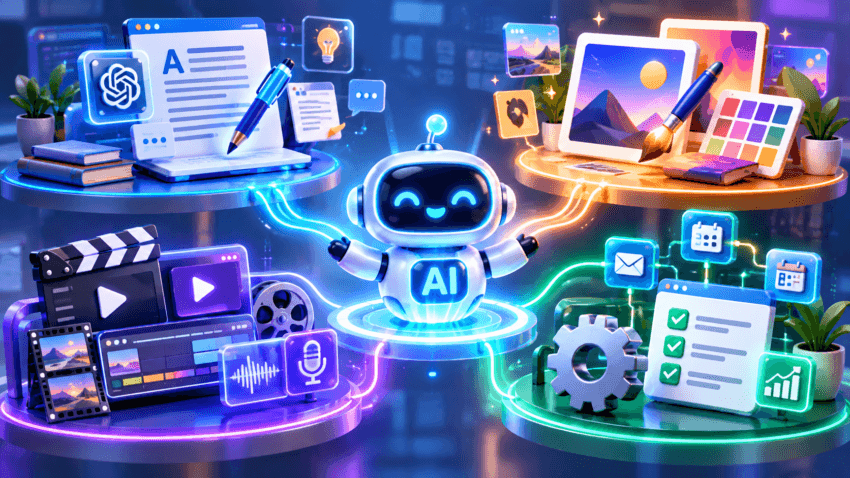
AI has made some kinds of work faster. It hasn’t discovered a secret button for making money.
That’s an important distinction if you’re looking for the best side hustles using AI.
Someone still needs to find the customer, understand their needs, check the work, fix mistakes, and deliver something worth paying for.
The better question isn’t “How can AI make money for me?”
It’s:
“What useful service can I provide with AI helping me?”
Here are 10 realistic places to start.
Affiliate Disclosure: This article contains affiliate links. If you join Wealthy Affiliate through one of my links, I may earn a commission at no additional cost to you. I recommend only products and services I have personally used or genuinely believe will add value for my readers. All opinions expressed in this review are my own.
1. AI-Assisted Content Editing
Instead of selling untouched AI-generated articles, offer a service that improves content.
You might help clients:
- Improve rough drafts
- Rewrite confusing sections
- Create stronger headings
- Condense long material
- Adapt tone for a specific audience.
- Proofread and format content.
Tools such as ChatGPT, Claude, and Grammarly can speed up parts of the process.
But don’t unquestioningly trust the output. Facts, quotations, statistics, links, product details, and other claims still need verification.
The value you’re selling is good editing and judgment, not access to an AI chatbot.
2. Content Repurposing
Businesses often create something once and need it turned into several other formats.
A webinar might become a blog outline, email, social posts, FAQ, and short-video scripts.
AI can help extract themes and create first drafts. Your job is to decide what matters, remove repetition, preserve the client’s voice, and make each piece appropriate for its platform.
This can be especially useful if you already understand writing or social media.
3. AI-Assisted Social Media Services
You could help a small business brainstorm content ideas, draft captions, organize a content calendar, or repurpose existing material.
AI makes brainstorming faster, but publishing 30 generic posts isn’t much of a service.
A stronger offer combines AI with:
research + brand knowledge + editing + scheduling + human review
Be careful with confidential information, customer data, copyrighted material, and claims about products or competitors.
4. Presentation and Document Creation
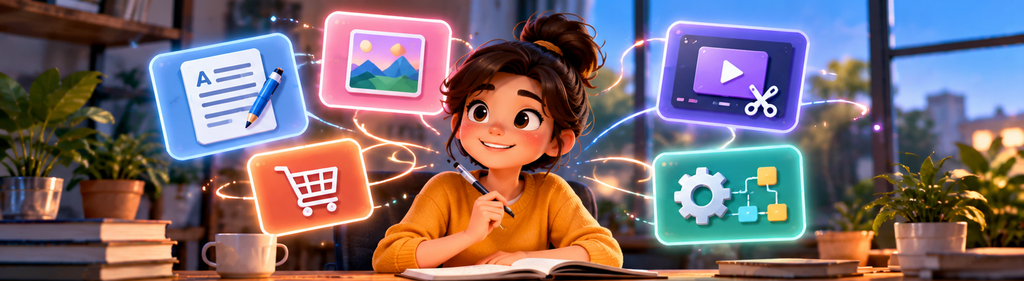
Not every AI side hustle has to involve social media.
Businesses need presentations, proposals, training documents, checklists, reports, and internal guides.
Tools such as ChatGPT and Canva can help organize information and create drafts or visuals. You then turn those ingredients into something clear and usable.
This is particularly useful if you’re already good at organizing messy information.
Want more practical ways to use AI without falling for the hype? Explore EasyMonitize for beginner-friendly guides on AI tools, blogging, SEO, affiliate marketing, and building an online business.
5. AI-Assisted Graphic Creation
Generative AI can help create illustrations, backgrounds, concepts, marketing graphics, and other visual assets.
But typing a prompt and handing over the first result isn’t graphic design.
Commercial work may involve trademarks, copyrighted characters, recognizable people, licensing restrictions, or outputs that resemble existing material.
If you’re selling visual work, learn the rules of both the AI tool and the marketplace where you sell it.
Then add something genuinely yours: selection, composition, editing, typography, branding, or another meaningful creative contribution.
6. Short-Form Video Repurposing
Businesses, educators, podcasters, and creators often have long videos they can repurpose into shorter content.
AI tools can assist with:
- Transcription
- Identifying possible clips
- Captions
- Summaries
- Script ideas
- Translation
- Basic editing
Your service is turning raw material into polished content—not pressing an automatic-clipping button.
You’ll still need to check context, names, captions, timing, branding, and factual accuracy.
7. Ecommerce Listing Improvement
Online sellers often need help improving product titles, descriptions, FAQs, category information, and other listing content.
AI can speed up drafting, especially when you have many products.
But don’t let it invent features, materials, certifications, dimensions, warranties, or benefits.
Build your drafts from verified product information supplied by the seller and review everything before publication.
8. Simple AI and Workflow Automation
This option has a slightly higher learning curve, but it can also involve more problem-solving.
Small businesses repeat plenty of tasks: organizing inquiries, summarizing information, routing forms, preparing standard responses, or moving information between approved tools.
Automation platforms and AI tools can sometimes reduce that manual work.
Start with simple, low-risk workflows. Learn how each step works before automating anything important.
And never feed confidential client information into an AI service simply because it’s convenient.
9. AI-Assisted Research and Organization
AI can help organize large amounts of information, summarize documents, develop research questions, compare material, or create an initial structure for a report.
There’s a catch:
AI can confidently produce information that is incomplete, outdated, misunderstood, or simply wrong.
That makes human verification part of the service.
This work is better suited to organizing and assisting research than presenting an AI-generated answer as authoritative professional advice.
10. AI-Assisted Digital Products
Templates, worksheets, planners, educational materials, graphics, and other digital products can all incorporate AI into the creation process.
What they don’t provide is guaranteed “passive income.”
You still need a useful idea, a customer, quality control, marketing, customer service, and compliance with marketplace rules.
Platforms can also have specific policies for AI-generated products and disclosures.
Build something useful rather than flooding a marketplace with hundreds of nearly identical AI-generated files.
What AI Tools Do You Actually Need?
Probably fewer than you think.
A beginner might start with one general-purpose AI assistant and add specialized software only when a particular service requires it.
Depending on your work, that could eventually include tools for:
- Writing and research assistance
- Design
- Video editing
- Transcription
- Automation
- Audio
- Project management
Don’t subscribe to five platforms before you’ve earned anything.
A $20 tool that saves useful time can make sense. Five subscriptions eating your entire month’s revenue don’t.
What About AI Voiceovers and Voice Cloning?
Synthetic voice technology can be useful for legitimate narration and content production, but this area deserves extra caution.
Don’t clone or imitate someone’s voice without appropriate permission. The same principle applies to someone’s face, likeness, or identity.
For client work, establish who owns the source material, what you’re authorized to create, and where the finished content will be used.
“AI can do it” doesn’t mean you automatically have the right to do it.
Protect Your Client’s Information
This is one of the easiest AI mistakes to make.
A client sends you a confidential document, and you immediately paste the whole thing into an AI tool.
Don’t assume that’s acceptable.
Before uploading client information, understand the tool’s current privacy and data-use terms and follow whatever confidentiality agreement you have with the client. Upwork’s current guidance similarly warns freelancers to address whether client data may be entered into public AI tools. Upwork
When in doubt, ask.
Can You Copyright AI-Generated Work?
Don’t assume that paying for an AI tool automatically gives every output full copyright protection.
Copyright rules vary by jurisdiction, and the legal treatment of generative AI continues to develop. In the United States, current Copyright Office guidance emphasizes human authorship; AI assistance doesn’t automatically prevent protection, but prompting alone isn’t necessarily enough. U.S. Copyright Office
There’s another distinction worth understanding:
A platform giving you contractual rights to use an output isn’t necessarily the same thing as that output qualifying for copyright protection.
For example, Canva’s current AI terms allow broad lawful use of many outputs while also warning that outputs may not be unique and that licensing can differ when other licensed content or AI-generated audio is involved. Canva
Check the current terms of whatever tool you use before selling the result.
How Much Can You Make With an AI Side Hustle?
There’s no useful universal number.
Your income depends on the service, skill level, clients, pricing, competition, expenses, available time, and whether anyone actually wants what you’re offering.
AI doesn’t remove those variables.
Instead of asking how much somebody else supposedly made, calculate:
Revenue – platform fees – AI subscriptions – other expenses – taxes = what you actually keep
And don’t forget your time.
How to Start an AI Side Hustle

Keep the beginning boring.
Choose one skill, one problem, and one type of customer.
For example:
“I help small businesses turn long articles into edited social-media content.”
That’s much clearer than:
“I provide AI services.”
Create a few honest samples. Learn one or two tools well. Decide what you’ll charge. Understand your platform’s rules. Then look for your first real customer.
Don’t pretend to have experience you don’t have.
Final Thoughts: Don’t Sell AI. Sell the Result.
AI tools will change. Today’s popular model could be replaced by something better next year.
Useful skills last longer.
Learn how to write, edit, research, design, communicate, organize, solve problems, and understand what customers actually need. Then use AI where it genuinely improves your workflow.
That’s a much stronger foundation than trying to build a business around whatever tool happens to be trending this month.
Want to build practical online skills alongside AI? Visit EasyMonitize for realistic guides on AI tools, blogging, affiliate marketing, SEO, and building an online business.