


Affiliate product reviews can generate income while helping readers make better buying decisions. But successful reviews do more than summarize features or place links around a sales pitch. They answer a specific buyer question, demonstrate real product knowledge, and explain both the benefits and the limitations.
This guide explains how to create affiliate product reviews that are useful, credible, search-friendly, and capable of converting readers into customers.
Affiliate Disclosure: This article contains affiliate links. If you join Wealthy Affiliate through one of my links, I may earn a commission at no additional cost to you. I only recommend products and services I have personally used or genuinely believe provide value to my readers. All opinions expressed in this review are my own.
Why Affiliate Product Reviews Work
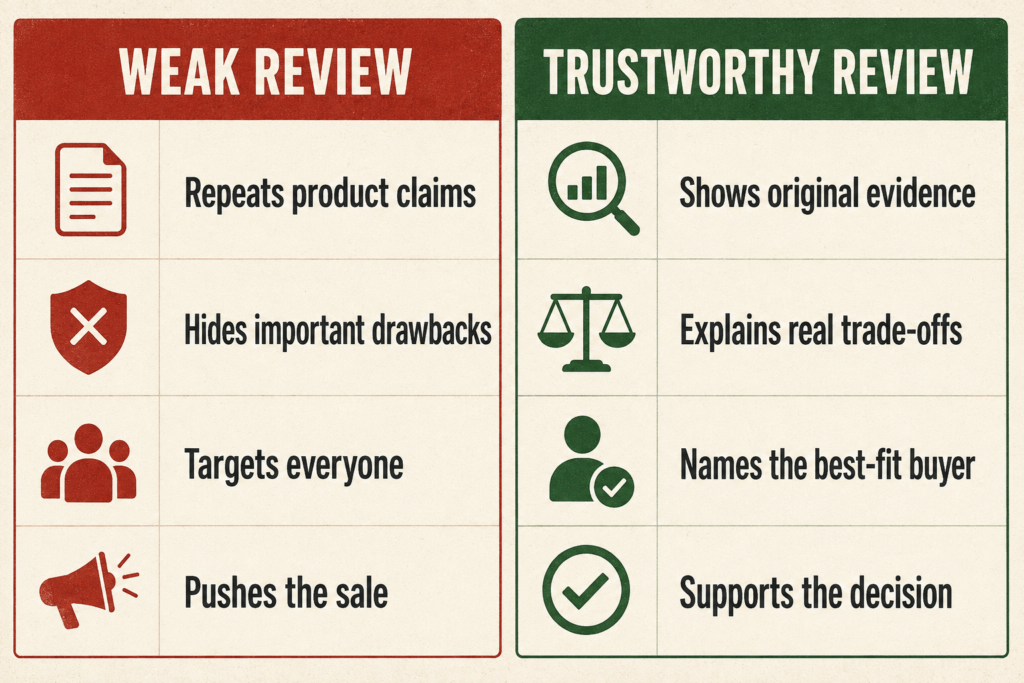
Shoppers often research products before spending money. They want to know whether an item performs as promised, how it compares with alternatives, and whether it suits their particular needs.
A useful review reduces that uncertainty. Instead of repeating a manufacturer’s description, it provides context that a product page may not offer:
- How the product performs in realistic conditions
- Which features matter in everyday use
- What limitations buyers should expect
- Who will benefit from the product
- When an alternative is a better choice
Google says its reviews system is designed to reward insightful analysis and original research written by people who know the subject. Thin articles that merely summarize existing product descriptions are unlikely to offer the same value.
Choose a Focused Niche
A clear niche makes it easier to build expertise and attract the right audience. Rather than reviewing unrelated products, concentrate on an area you understand or are prepared to test thoroughly. Examples include lightweight hiking equipment, small-space kitchen appliances, home-office accessories, or technology for older adults.
Before committing to a niche, consider:
- Experience: Can you evaluate these products credibly?
- Demand: Are people actively researching and buying them?
- Depth: Can you publish comparisons, tutorials, and long-term updates?
- Access: Can you obtain products or reliable demonstrations?
- Commercial fit: Are reputable affiliate programs available?
WordPress is a popular publishing option because it supports flexible layouts, search optimization, and link-management tools. Hosted website builders and newsletter platforms can also work. Choose a platform that lets you publish disclosures, comparison tables, original media, and clearly labeled affiliate links.
How to Write an Affiliate Product Review
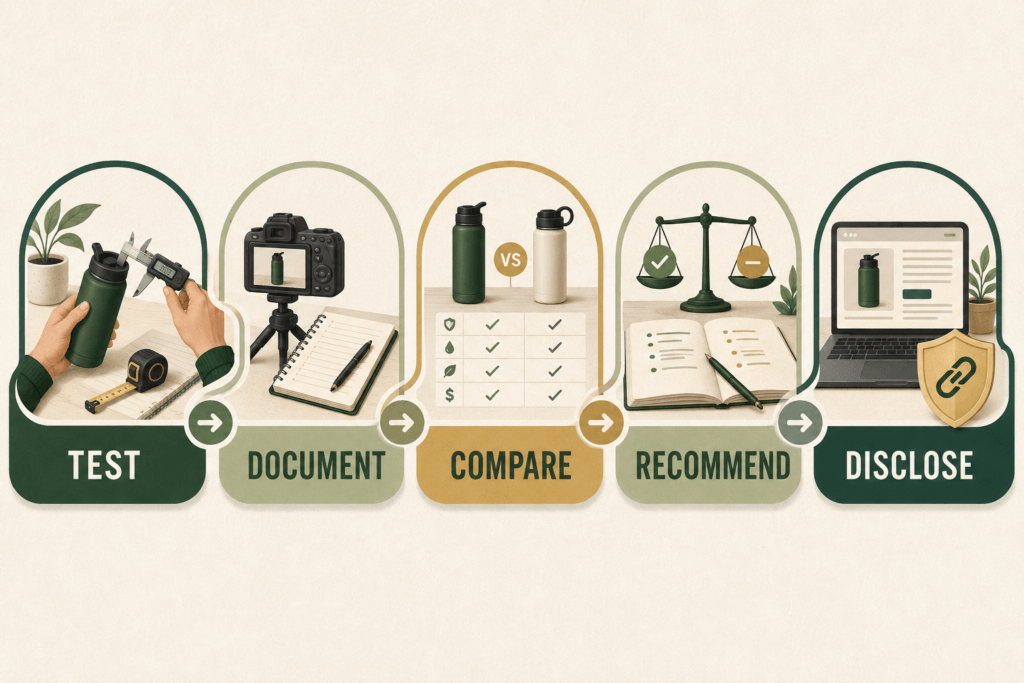
1. Identify the Reader’s Buying Question
Start with a specific search intent rather than a broad product name. A reader may want to know:
- Is this product worth the price?
- Does it work for beginners?
- How does it compare with a competing model?
- Will it solve a particular problem?
- What are its weaknesses after extended use?
Keyword tools can help identify common wording, but the article should satisfy the underlying question rather than repeat an exact phrase unnaturally. Avoid adding a year to the title unless the review is genuinely updated and the date helps the reader.
2. Test the Product—or Explain Your Research Honestly
Firsthand testing is the strongest foundation for a review. Record how long you used the product, the conditions in which you tested it, and the criteria you applied. For a hiking backpack, those criteria might include loaded comfort, capacity, adjustment range, water resistance, weight, and durability.
Collect useful evidence such as:
- Original photographs or video
- Measurements and timed tests
- Notes from repeated use
- Comparisons with products you have also tested
- Relevant instructions, specifications, or warranty terms
Do not write as though you used a product if you did not. The U.S. Federal Trade Commission states that endorsers cannot describe an experience they have not had. A research-based overview can still be valuable, but it should be labeled accurately and should not be presented as a personal review.
3. Lead With a Quick Verdict
Many readers want the conclusion before the details. Near the top, summarize:
- Your overall assessment
- The product’s strongest advantage
- Its most important limitation
- The type of buyer it suits
For example: “This is a comfortable, well-organized daypack for short hikes, but its limited weather protection makes it a poor choice for frequent use in heavy rain.”
This is more informative than simply calling the product “excellent” or assigning an unexplained star rating.
4. Describe Your Evaluation Method
Explain how you reached your conclusion. A transparent method makes the review more trustworthy and helps readers decide whether your priorities match theirs.
Include:
- Testing period and conditions
- Relevant experience or expertise
- Performance criteria
- Comparison products or benchmarks
- Any limits affecting the review
If a brand supplied the product, sponsored the content, or allowed you to keep a sample, disclose that relationship even if your opinion was not influenced.
5. Analyze Performance, Not Just Features
A feature list says what the product has. A review explains what those features mean in practice.
Instead of writing “The headlamp has a rechargeable battery,” report how long the battery lasted at a stated brightness, how quickly it charged, and whether the controls were easy to operate with gloves. Specific observations help readers understand the trade-offs.
Where appropriate, verify technical claims using official manuals or documentation. Clearly distinguish manufacturer claims from your own test results.
6. Include Meaningful Pros and Cons
Every product has limitations. Discussing them does not weaken a recommendation; it makes the recommendation more credible.
Avoid generic points such as “great quality” or “a little expensive.” Explain why each advantage or disadvantage matters. A heavier tent may be unsuitable for backpacking but perfectly reasonable for car camping. The context determines whether a characteristic is a flaw.
7. Explain Who Should—and Should Not—Buy It
Translate your findings into a practical recommendation. Identify the product’s ideal user, then name the people who would be better served by another option.
Alternatives are especially useful when they address a clear limitation. Rather than listing several competing products without explanation, state why someone might choose each one: lower price, lighter weight, greater durability, simpler controls, or a better warranty.
8. Add Affiliate Links Without Overloading the Page
Place links where they support a natural next step, such as after the verdict or final recommendation. Use descriptive language such as “Check current price” instead of misleading or high-pressure calls to action.
Do not quote retailer prices unless you can keep them accurate and your affiliate agreement permits it. Likewise, do not copy customer reviews, ratings, or product images without authorization. Each affiliate program has its own rules governing trademarks, pricing, images, and other supplied content.
9. Make the Affiliate Disclosure Easy to Notice
The FTC advises placing a disclosure with the endorsement where people are likely to see and understand it. A disclosure buried in a footer, on a separate page, or behind a “more” link may be missed.
Use plain language, for example:
Disclosure: If you buy through links in this review, I may earn a commission at no additional cost to you.
For video reviews, include the disclosure in the video rather than relying only on the description. Follow the laws that apply to your audience and the terms of every affiliate program you join.
10. Update the Review
Products, prices, and program terms change. Check important reviews regularly and note the date of any material update. Verify:
- Product availability and specifications
- Broken or redirected links
- Warranty or subscription changes
- New models and stronger alternatives
- Whether your original verdict remains accurate
Do not change the displayed date without making a meaningful revision. Readers benefit from knowing what was actually updated.
Recommended Affiliate Review Structure
Use this outline as an affiliate product review checklist:
- Clear affiliate disclosure
- Brief introduction focused on the buyer’s problem
- Quick verdict
- Product overview and key specifications
- Testing or research methodology
- Performance by evaluation criterion
- Meaningful pros and cons
- Best-fit and poor-fit buyers
- Relevant alternatives
- Final recommendation and natural call to action
- Publication or update date
For a roundup, explain how products were selected and tested, then give each item a specific award such as “best for small spaces” or “best budget option.” Avoid naming every product “best” without defensible criteria.
Common Affiliate Review Mistakes
- Rewriting the sales page: Readers need analysis, not duplicated marketing copy.
- Inventing personal experience: Be precise about what you tested and what you researched.
- Hiding the disclosure: Put it near the endorsement in language readers understand.
- Ignoring drawbacks: Unqualified praise appears promotional and rarely helps buyers.
- Using unsupported ratings: Explain the criteria and evidence behind a score.
- Copying third-party content: Obtain permission and follow the affiliate program’s usage rules.
- Publishing outdated information: Recheck links, specifications, availability, and conclusions.
- Writing for keywords instead of people: Cover the buyer’s question completely and naturally.
Frequently Asked Questions
How long should an affiliate product review be?
There is no ideal word count. The review should be long enough to answer the buyer’s important questions without padding. A straightforward product may need less explanation than a technical comparison involving several models.
How many affiliate links should a review contain?
Use only as many as readers need to take the next step. Link placement and relevance matter more than an arbitrary total. Too many repeated links can make a review difficult to read and overly promotional.
Can I review a product I have not used?
You can publish a clearly labeled research-based comparison or overview, but you should not claim or imply firsthand experience. Whenever possible, obtain the product and conduct meaningful tests before recommending it.
Should I include customer-review quotes?
Only when you have the right to reproduce them and can provide appropriate context. It is usually safer and more useful to summarize recurring customer feedback in your own words while identifying the source and avoiding claims you cannot verify.
Final Thoughts
The best affiliate product reviews put the reader’s decision first. Choose a focused question, gather original evidence, explain your evaluation method, disclose financial relationships, and acknowledge genuine shortcomings. Then recommend the product only to the people it is likely to serve well.
That approach may be less aggressive than a sales pitch, but it creates something more valuable: a review readers can trust, revisit, and confidently act on.