


Finding affiliate products is easy. Finding products that your audience actually wants—and that belong to reliable, worthwhile affiliate programs—is much harder.
In 2026, successful affiliate marketing isn’t about chasing the highest advertised commission. It’s about matching useful products with the right audience and evaluating the entire opportunity: customer demand, product quality, conversion potential, average order value, attribution rules, recurring revenue, and program reliability.
This guide will show you how to find affiliate products to promote, evaluate affiliate programs, research demand, and turn promising products into useful content.
Affiliate Disclosure: This article contains affiliate links. If you join Wealthy Affiliate through one of my links, I may earn a commission at no additional cost to you. I identify products I have personally used where relevant. I may also recommend products based on independent research, and I aim to explain the basis for each recommendation. All opinions are my own.

1. Choose Your Niche Before Choosing Products
Start with your audience—not the commission.
A clearly defined niche makes it easier to identify products your readers or viewers genuinely need. It also prevents you from filling your content with unrelated recommendations simply because they offer attractive payouts.
Ask yourself:
- What problems does my audience regularly need to solve?
- What products or services are they already buying?
- Do they need physical products, software, services, courses, or a combination?
- Which products can I credibly review, demonstrate, or compare?
- Is there enough demand to create useful content consistently?
For example, a home fitness site could promote equipment, workout apps, recovery products, or training subscriptions.
A website for small-business owners might focus on accounting software, email marketing platforms, web hosting, productivity tools, and other SaaS products.
The best niche isn’t necessarily the one with the biggest commissions. It’s one where you can consistently help people make better purchasing decisions.
Action Step: Write down three problems your audience regularly faces, then identify products that solve each one. That’s a much stronger starting point than randomly browsing affiliate networks.
2. Search Established Affiliate Networks
Affiliate networks connect publishers and creators with companies willing to pay commissions for referred sales or other qualifying actions.
Instead of applying separately to dozens of companies, you can use networks and partnership platforms to discover programs and manage tracking and payments.
Affiliate Networks to Explore in 2026
Awin
Awin is a major global affiliate network covering industries such as retail, travel, finance, technology, and telecommunications.
If you’ve encountered older guides recommending ShareASale, note that ShareASale is no longer a standalone affiliate platform. It officially closed on October 6, 2025, after migrating active customers and programs to Awin.
CJ
CJ is an established affiliate marketing platform with brands across numerous industries. Its reporting capabilities can help publishers evaluate actual performance rather than comparing programs solely by advertised commission rates.
impact.com
impact.com combines affiliate and broader partnership management. Its marketplace can help you discover brands and manage partnerships.
ClickBank
ClickBank is particularly well known for digital products and direct-response offers.
Quality can vary widely between offers, so don’t choose a product just because it advertises an unusually high commission.
FlexOffers
FlexOffers provides another large directory of advertiser programs across multiple industries.
You don’t need accounts with every affiliate network. Start with one or two that offer strong coverage in your niche.
3. Look for Direct Affiliate Programs
Not every worthwhile affiliate program appears in a large network.
Many SaaS companies, online services, retailers, and specialist brands operate their own programs or use partnership platforms behind the scenes.
Try searches such as:
[brand name] affiliate program[product category] affiliate program[niche] affiliate programs[software name] partner program[brand name] referral program
You can also check company websites for sections labeled Affiliates, Partners, Creators, or Referral Program.
Direct programs are particularly worth investigating when you already use and recommend the company’s product.
4. Evaluate the Entire Offer—Not Just the Commission
This is where many new affiliates go wrong.
A larger commission percentage doesn’t automatically make a product more profitable.
Instead, evaluate the complete opportunity.
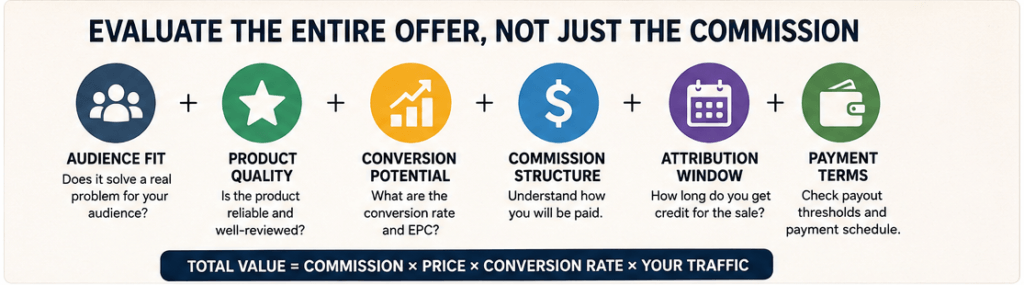
Audience FitAudience Fit
Would your audience realistically buy this product?
A highly relevant product with a smaller payout can generate significantly more revenue than an unrelated product offering a larger commission.
Product Quality
Whenever possible, use or test the product yourself.
Firsthand experience can help you produce better reviews, tutorials, comparisons, screenshots, demonstrations, and answers to questions prospective buyers actually have.
If you haven’t personally used a product, don’t imply that you have. Be clear about whether your recommendation comes from firsthand experience, independent research, or another basis.
Conversion Potential
Some affiliate platforms provide performance metrics such as:
- conversion rate
- earnings per click (EPC)
- average order value
- average commission
- refund or reversal information
Use these numbers when available, but remember network averages don’t guarantee the same results for your audience.
Commission Structure
Instead of looking for an arbitrary “good commission percentage,” understand exactly how you’ll be paid.
A program might offer:
- percentage-based commissions
- fixed payments per sale
- payments for qualified leads
- recurring subscription commissions
- tiered commissions
- performance bonuses
rather than judging a program solely by commission percentage.
A smaller commission on a product that converts well can outperform a much larger commission on an offer few people want.
For subscription products, recurring commissions and customer retention may also affect the long-term economics.
Attribution Window
Check how long a referral remains eligible for attribution after someone clicks your affiliate link.
Longer attribution periods can be useful for products with longer buying cycles, though exact attribution rules vary by program.
Payment and Reversal Terms
Before promoting an offer, understand:
- minimum payout thresholds
- payment frequency
- supported payment methods
- refund periods
- commission reversals
- attribution rules
These details affect how much money ultimately reaches your account.
Action Step: Compare three potential products based on audience fit, product quality, conversion data, average order value, commission structure, attribution window, and payment terms. The strongest opportunity may not have the highest advertised commission.
5. Research Demand Before Creating Content
Don’t spend days writing a review for a product nobody wants to buy.
Look for evidence of demand first.
Use Google Trends
Google Trends can show whether relative search interest in a product, brand, or category is growing, declining, or seasonal.
Compare several related products rather than examining one term in isolation.
Keep in mind that Google Trends shows relative search interest, not exact search volume, so use it alongside other demand signals.
Study Search Results
Search queries such as:
[product] review[product A] vs [product B]best [product category] for [specific use][product] alternativesis [product] worth it[product] pricing
These searches can reveal commercial intent and potential gaps in existing content.
Research Customer Discussions
Reddit, specialist forums, YouTube comments, Facebook groups, Discord communities, and product-review sites can reveal the language customers use when discussing problems.
Don’t enter communities simply to drop affiliate links. Use discussions for audience research unless the community explicitly permits promotional content.
Pay particular attention to repeated:
- questions
- complaints
- objections
- comparisons
- feature requests
- purchasing concerns
Those conversations can become excellent content ideas.
6. Ask Your Audience What They Actually Need
One of the simplest forms of affiliate research is also one of the most overlooked: asking your audience.
You can use:
- email surveys
- newsletter polls
- social media polls
- community questions
- reader comments
- customer interviews
Instead of asking:
“What product should I promote?”
ask about the underlying problem.
For example:
“What’s the biggest problem you’re currently having with your home office setup?”
Responses can reveal several product opportunities without turning your research into a sales pitch.
7. Study Competitors Without Copying Them
Competitor research can reveal which products already appear to have commercial demand in your niche.
Look at:
- products competitors review repeatedly
- comparison pages they publish
- brands appearing across several respected websites
- products receiving prominent placement
- topics attracting discussion and links
But don’t assume a competitor promotes a product because it converts well.
Prominent placement could reflect sponsorships, affiliate relationships, legacy content, commercial agreements, or other factors you can’t see.
The goal isn’t to copy another publisher’s recommendations. Use competitor research to identify opportunities, then evaluate and create something more useful.
8. Build Your Own Affiliate Product Database
As you discover programs, keep track of them.
A simple spreadsheet can include:
- program
- product
- affiliate network
- commission structure
- attribution window
- payout threshold
- conversion or EPC data
- application status
- content opportunities
- clicks
- conversions
- actual revenue
This becomes increasingly valuable as your affiliate business grows.
Eventually, your own performance data will tell you far more than generic lists of “highest-paying affiliate programs.”
Review your tracker monthly or quarterly to identify which products deserve more attention and which should be replaced.
9. Turn Product Research Into Useful Content
Once you’ve selected a product, don’t simply insert affiliate links into unrelated articles.
Create content that helps someone solve a problem or make a purchasing decision.

Write Useful Product Reviews
A strong review should explain:
- who the product is for
- who should avoid it
- major strengths
- meaningful drawbacks
- pricing
- alternatives
- your experience with it, when applicable
Avoid describing every product as “amazing,” “game-changing,” or “the best.”
Specific evidence is more persuasive than exaggerated praise.
Publish Product Comparisons
Comparison content can be particularly useful when customers are already deciding between two solutions.
For example:
Kit vs. Mailchimp: Which Is Better for a Small Newsletter?
is more specific than:
10 Amazing Email Marketing Tools You Need Today
Specificity gives readers—and search engines—a clearer understanding of the problem your article solves.
Create Tutorials
Tutorials let you demonstrate a product while solving an actual problem.
Examples include:
- how to build a landing page with a particular platform
- how to choose running shoes for flat feet
- how to configure a microphone for podcasting
- how to automate invoices with accounting software
The product becomes part of the solution rather than the sole focus of the article.
Create “Best For” and Alternatives Guides
Narrow your recommendations around specific buyers.
For example:
Best Project Management Software for Five-Person Remote Teams
is more useful than:
10 Best Project Management Tools
The narrower article gives you room to explain why each recommendation suits a particular buyer.
Use Helpful Affiliate CTAs
A call to action should be the logical next step after you’ve given the reader enough information to decide.
For example:
Think this product fits your needs? Check the latest pricing, features, and availability before deciding.
For software:
Want to try it yourself? View the current plans and see whether a free trial or demo is available.
Avoid manufactured urgency. Claims such as “Only 2 left!” or “Price ends tonight!” shouldn’t be used unless you can verify they’re accurate.
The best CTA doesn’t pressure the reader. It makes the next step obvious.
10. Disclose Affiliate Relationships Clearly
Affiliate disclosures aren’t something to hide in the footer.
If you receive compensation when someone purchases through your links, readers should be able to understand that relationship.
A straightforward disclosure could say:
Disclosure: I may earn a commission if you purchase through links in this article, at no additional cost to you.
Place your disclosure prominently where readers will notice it rather than relying solely on a separate disclosure-policy page.
When additional clarity near a recommendation or CTA would help, you can use:
Disclosure: If you purchase through this link, I may earn a commission at no additional cost to you.
Requirements can vary by jurisdiction, so check the rules that apply to your business and audience.
11. Review Your Affiliate Programs Regularly
Affiliate programs change.
Companies can modify commissions, attribution periods, policies, products, pricing, or entire affiliate platforms.
Review important partnerships periodically and ask:
- Is the program still active?
- Has its commission structure changed?
- Are my tracking links working?
- Has the product’s price changed?
- Is my review still accurate?
- Are there better alternatives?
- Are readers clicking but not converting?
- Are commissions being reversed frequently?
A quarterly review can be more productive than constantly chasing newly launched programs.
It also reduces the risk of leaving outdated pricing, broken links, or obsolete recommendations in your content.
Affiliate Product Research Checklist
Before promoting an affiliate product:
- Define the audience problem.
- Find relevant products and affiliate programs.
- Verify customer demand.
- Evaluate product quality and reputation.
- Compare the complete economics of each offer.
- Understand attribution and payment terms.
- Test the product when possible.
- Choose the appropriate content format.
- Add a clear affiliate disclosure.
- Track clicks, conversions, commissions, and reversals.
- Improve or replace offers based on actual results.
Final Thoughts
Learning how to find affiliate products to promote isn’t about building the longest possible list of programs—or finding the program with the biggest commission percentage.
It’s about finding products that solve genuine problems for your audience.
Start with what your audience needs. Research products carefully. Compare the complete economics of each affiliate program. Then create useful reviews, comparisons, tutorials, and buying guides that help people make informed decisions.
Over time, pay attention to your own data. Your clicks, conversions, revenue, reversals, and audience feedback will tell you which products deserve more of your attention.
That approach may be slower than publishing dozens of generic affiliate articles, but it builds something much more valuable: trust.
And trust is what gives affiliate content long-term value.
Ready to Find Your First Affiliate Product?
Choose one audience problem, find three products that solve it, and compare them using the criteria in this guide.
Then select the strongest option and create one genuinely useful piece of content around it—a review, comparison, tutorial, or buyer’s guide.
Start with relevance, prove the value, and let the commission follow.
