



If you want to learn how to start affiliate marketing, you’ve probably already discovered the problem: there’s a lot of advice out there, and much of it makes earning money online sound either incredibly complicated or suspiciously easy.
Affiliate Disclosure: This article contains affiliate links. If you join Wealthy Affiliate through one of my links, I may earn a commission at no additional cost to you. I only recommend products and services I have personally used or genuinely believe provide value to my readers. All opinions expressed in this review are my own.
At Easy Monitize, we take a different approach.
Our goal is to help beginners build online income with practical strategies they can actually understand and use. That means no promises of overnight success and no assumption that you already have a huge audience, expensive software, or years of marketing experience.
Affiliate marketing can be a good place to start because you don’t need to create your own product. You recommend useful products or services, and when someone makes a qualifying purchase or takes another specified action through your affiliate link, you may earn a commission.
But building meaningful affiliate income takes more than dropping links on the internet.
You need the right niche, useful content, relevant offers, consistent traffic, and enough patience to build something that can keep producing results over time.
In this Easy Monitize guide, we’ll show you how to start affiliate marketing step by step, including how to choose a niche, find affiliate programs, create content, promote your links, and turn those first efforts into a long-term online income strategy.
What Is Affiliate Marketing?
Affiliate marketing is a business model where you promote another company’s products or services in exchange for a commission or other compensation when your referral completes a qualifying action.
Here’s the simple version:
You create useful content → someone discovers it → they click your affiliate link → they make a qualifying purchase → you may earn a commission.
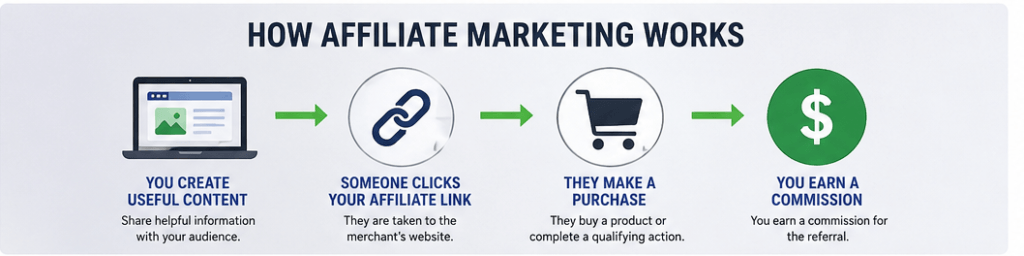
The company handles the product, payment processing, fulfillment, and customer service. Your job is to help the right people discover products or services that may be useful to them.
That makes affiliate marketing appealing to beginners because you can focus on building an audience and creating helpful content instead of developing a product from scratch.
How Affiliate Marketing Works
There are usually four main parts:
- The merchant: The company selling the product or service.
- The affiliate: You—the person promoting the offer.
- The consumer: The person considering or purchasing the product.
- The affiliate network: In some cases, a platform that connects merchants and affiliates and handles tracking.
When you join an affiliate program, you generally receive a unique tracking link. That link helps the company determine which customers or conversions came from your content.
How Do Affiliate Marketers Get Paid?
Affiliate programs use different compensation models.
Pay per sale: You earn a commission when your referral makes a qualifying purchase.
Pay per lead: You get paid when someone completes a specified action, such as signing up for a trial.
Pay per click: Some programs pay for qualifying clicks, although this model is less common.
For beginners, the important thing isn’t finding the program with the biggest advertised commission.
It’s finding relevant products that solve real problems for the audience you want to build.
That distinction matters if your goal is long-term income.
How to Start Affiliate Marketing in 8 Steps
You don’t need to build an entire affiliate business in one weekend.
A better approach is to build it one piece at a time:
- Choose a focused niche.
- Find relevant affiliate programs.
- Pick your main content platform.
- Research what your audience needs.
- Create useful content.
- Add and promote affiliate links naturally.
- Track your results.
- Build on what works.
Let’s walk through each step.
Step 1: Choose the Right Affiliate Marketing Niche
Your niche is the main subject your content will cover.
This decision matters because it affects almost everything that comes later: your audience, keywords, products, content ideas, competition, and earning opportunities.
For example, “fitness” is an extremely broad niche.
A more focused niche could be “home fitness for beginners.”
Instead of trying to reach everyone interested in fitness, you can create content specifically for people who want to exercise at home.
How to Choose an Affiliate Marketing Niche
At Easy Monitize, we recommend looking for the overlap between four things:
1. Something you can keep learning about
You don’t necessarily need to be an expert on day one. But you should be willing to research the subject and create content about it consistently.
2. Problems people want to solve
Good niches contain real questions.
What are people trying to learn, fix, compare, buy, or accomplish?
Those problems become potential content ideas.
3. Products or services people already buy
Research whether reputable companies in the niche offer affiliate programs.
A niche can attract plenty of traffic without necessarily providing good monetization opportunities.
4. Enough demand to build an audience
Use keyword research tools, search results, forums, social platforms, and online communities to see what people are asking about.
You’re looking for evidence of sustained interest—not simply the hottest trend this week.

Popular Affiliate Marketing Niches
Common niches include:
- Technology and software
- Home and garden
- Health and wellness
- Personal finance
- Fashion and beauty
- Online education
- Business tools
- Hobbies and recreation
Remember the Easy Monitize approach: don’t choose a niche only because someone says it makes money.
If you want to build long-term income, choose a subject where you can realistically publish useful content for months or years.
Step 2: Find Affiliate Programs That Fit Your Audience
Once you have a niche, you need something relevant to promote.
This is where beginners sometimes make their first major mistake.
They search for the affiliate programs with the highest commissions instead of asking which products actually make sense for their audience.
Start with the audience.
Then find the offer.
What Makes a Good Affiliate Program for Beginners?
Look for:
- A reputable company
- Products relevant to your niche
- Clear commission terms
- Reasonable application requirements
- Useful tracking and reporting
- Affiliate support or resources
- A payout structure you understand
- Promotional rules that fit your strategy
Before promoting anything, read the program’s current terms.
You need to know how commissions are calculated, where you’re allowed to place links, what disclosures are required, and what could cause a commission to be rejected.
Affiliate Programs Beginners Can Research
Depending on your niche, established platforms and programs you might investigate include:
- Amazon Associates
- ShareASale
- Rakuten Advertising
- ClickBank
- Impact
- Fiverr Affiliates
These aren’t automatically the “best” choices for every beginner.
The right program is the one that gives you relevant products your audience may genuinely want.
Start small.
You don’t need accounts with 20 affiliate networks. A few well-matched offers are enough to learn how the process works.
Step 3: Choose Where You’ll Build Your Audience
Affiliate links don’t create income by themselves.
You need people to discover them.
That means choosing a platform where you can consistently create content and build an audience.
Start a Blog or Website
A website is especially useful if your long-term strategy involves organic search traffic.
You can create:
- How-to articles
- Product reviews
- Comparison guides
- Buying guides
- Tutorials
- Resource pages
- Frequently asked questions
The advantage is that useful evergreen content can potentially continue attracting visitors long after you publish it.
That’s important for the kind of long-term income we focus on at Easy Monitize.
Instead of starting from zero every day, you’re gradually building a library of content that can keep working for you.
Start a YouTube Channel
If you’re more comfortable speaking or demonstrating things than writing, YouTube can be another option.
Tutorials, reviews, comparisons, demonstrations, and educational videos can naturally introduce relevant products.
Use Social Media
Platforms such as TikTok, Instagram, Facebook, and others can help you reach an audience without creating a website first.
The downside is that you’re building on someone else’s platform.
Algorithms and platform rules can change.
For that reason, long-term affiliate businesses often benefit from eventually owning an asset such as a website or email list instead of depending entirely on social media.
Step 4: Learn How to Start Affiliate Marketing With No Money
You don’t need an expensive setup to test affiliate marketing.
If your budget is zero or close to it, start lean.
You can use:
- Free social media accounts
- YouTube
- Free blogging platforms
- Free keyword research resources
- Free tiers of selected marketing tools
Then reinvest some of your earnings as the business grows.
A Simple Zero-Budget Affiliate Marketing Plan
If we were starting from scratch with almost no money, we’d keep the process simple:
1. Pick one niche.
Don’t try to cover everything.
2. Choose one primary platform.
Learn how that platform works before spreading yourself across five others.
3. Join one or two relevant affiliate programs.
You only need enough products to begin testing your content.
4. Create useful content consistently.
Answer questions your target audience is already asking.
5. Track what gets attention.
Find the topics and recommendations that produce traffic, clicks, or conversions.
6. Reinvest gradually.
When you begin earning, you can decide whether a domain, hosting, email software, content tools, or other investments could help you grow.
The goal isn’t to spend nothing forever.
The goal is to prove the idea before spending heavily on it.
Step 5: Create Content That Can Build Long-Term Traffic
This is where affiliate marketing becomes much more than sharing links.
Content is the engine.
Good affiliate content helps someone make a decision, solve a problem, or accomplish something.
Your affiliate link should support that goal.
It shouldn’t be the goal.
Affiliate Content That Works for Beginners
Here are several formats worth learning.
How-to guides
Teach someone how to accomplish something and recommend relevant tools when appropriate.
Product reviews
Help readers understand what a product does, who it’s for, where it performs well, and where it falls short.
Product comparisons
Compare two or more products for readers who are already considering a purchase.
Best-product guides
Help readers narrow down options based on different needs, budgets, or use cases.
Resource pages
Create a useful collection of tools or products for a specific audience.
Problem-solving content
Answer specific questions your target reader is searching for.

Create Assets, Not Just Posts
This is one of the most important Easy Monitize principles to understand.
Think of every useful piece of content as a small online asset.
One article probably won’t change your income.
But imagine building 20 useful articles.
Then 50.
Then 100.
Some won’t perform. Others might attract visitors every month.
Over time, you’re building a collection of content that can bring people into your business through search engines, social platforms, referrals, email, and other channels.
That’s a much stronger long-term strategy than constantly chasing the next viral post.
Step 6: Promote Affiliate Links Without Losing Trust
There is a big difference between affiliate marketing and affiliate spamming.
Posting links everywhere isn’t a strategy.
Instead, put links where they genuinely help someone take the next logical step.
For example, after explaining how a particular tool solves a problem, you might give the reader an opportunity to learn more about that tool.
Places You May Be Able to Promote Affiliate Links
Depending on the rules of the program and platform, these can include:
- Blog articles
- Product reviews
- Comparison pages
- Tutorials
- YouTube descriptions
- Social media content
- Resource pages
- Email content when permitted
Keep Trust Ahead of the Commission
Your audience is more valuable than a single commission.
That’s worth remembering.
If you recommend poor products simply because they offer high commissions, you may earn something today but lose trust tomorrow.
Long-term affiliate income works better when people learn that your recommendations are worth paying attention to.
Be clear about affiliate relationships and follow applicable disclosure requirements, including relevant FTC guidance.
Step 7: Track What Actually Makes Money
You don’t need to become an analytics expert.
But you do need to know what’s working.
Start by tracking:
- Website or content traffic
- Affiliate link clicks
- Conversion rates
- Leads or sales
- Affiliate revenue
- Your best-performing content
- Your best-performing offers
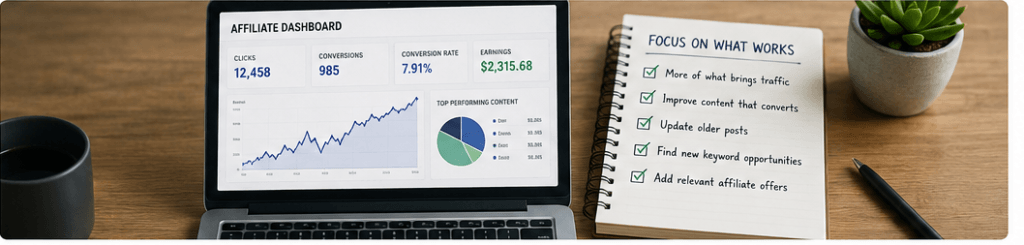
Then ask simple questions.
Which topics bring visitors?
Which pages get clicks?
Which offers convert?
Which content gets traffic but produces no affiliate activity?
Which successful topics could you expand?
Data helps turn affiliate marketing from guessing into a repeatable process.
Step 8: Turn Early Results Into Long-Term Income
Getting your first affiliate commission is exciting.
But at Easy Monitize, we’d rather help you think beyond the first sale.
The bigger goal is to create a system that becomes stronger over time.
Once something works, look for ways to build around it.
For example:
If one article ranks: Create related articles that answer the next questions your readers have.
If one product converts: Research complementary products or relevant alternatives.
If your traffic grows: Start building an email audience you can reach directly.
If one platform works: Strengthen it before expanding to another.
If old content performs: Keep it accurate and improve it rather than constantly starting over.
This creates a simple growth loop:
Create → Measure → Learn → Improve → Expand
You don’t need to guess your way to growth.
Let the results show you where to invest your next hour.
How Much Can You Make With Affiliate Marketing?
There’s no reliable number that every beginner can expect to earn.
Income varies based on your niche, traffic, products, commissions, conversion rates, content quality, competition, and experience.
You may see stories about affiliates earning $10,000 per month or much more.
Those results are possible for some established businesses, but they shouldn’t be treated as a normal beginner outcome or a promise.
At Easy Monitize, we’d rather focus on milestones that actually help you build something:
First, create useful content.
Then get your first visitors.
Then your first affiliate click.
Then your first conversion.
Then determine why it worked.
Then try to repeat it.
The goal isn’t simply to make your first $10.
It’s to learn how to build a system capable of generating the next $10—and eventually much more.
Common Affiliate Marketing Mistakes Beginners Should Avoid
Chasing Quick Money
If you’re constantly jumping to a new niche, product, or platform because someone posted an impressive income screenshot, you never give your existing strategy enough time to develop.
Build before you pivot.
Promoting Too Many Products
More affiliate links don’t automatically produce more affiliate income.
Fewer relevant recommendations can make your content easier to trust and more useful.
Choosing Products Only for the Commission
A 50% commission on a product nobody wants isn’t necessarily better than a smaller commission on something your audience genuinely needs.
Start with audience fit.
Creating Content Only to Sell
People usually aren’t searching Google because they want to click your affiliate link.
They’re searching because they need an answer.
Give them the answer.
Then introduce a relevant product when it genuinely helps.
Depending on One Source of Traffic
If your entire business depends on one social account or platform, one algorithm change can create a serious problem.
As you grow, consider diversifying through assets you control, such as your website and email list.
Giving Up Before You Have Enough Data
Affiliate marketing often takes time.
A handful of articles or a few weeks of posting usually isn’t enough information to judge an entire business model.
Create, measure, learn, and improve.
The Easy Monitize Affiliate Marketing Plan
If everything in this guide feels like a lot, forget about building the perfect affiliate business.
Start here.
Phase 1: Build the Foundation
Choose:
- One niche
- One target audience
- One main content platform
- One or two relevant affiliate programs
Phase 2: Build Your Content Library
Create content that answers the questions your audience is already asking.
Focus on usefulness before volume.
Phase 3: Get Traffic
Learn one primary traffic source well.
If you’re building a blog, that might mean SEO.
If you’re building on YouTube, learn YouTube search and recommendations.
Don’t try to master every traffic channel at once.
Phase 4: Get Your First Conversions
Track which content gets clicks and which products convert.
Don’t obsess over income yet.
You’re looking for proof that your system can work.
Phase 5: Double Down
Once you find something that works, do more of it.
Build related content.
Improve existing pages.
Add relevant offers.
Capture email subscribers.
Diversify your traffic.
Gradually turn isolated wins into a repeatable system.
That’s how you move from trying to make money online to building an online income asset.
Affiliate Marketing FAQ for Beginners
How do I start affiliate marketing as a beginner?
Choose a focused niche and target audience first. Then join relevant affiliate programs, select a content platform, and create useful content around problems your audience wants to solve. Add affiliate links where they’re genuinely relevant, disclose your relationship, and track your results so you can improve over time.
Can I start affiliate marketing with no money?
Yes. You can start with free platforms such as social media, YouTube, or free blogging tools and apply to affiliate programs that don’t require upfront fees. Starting lean allows you to test your idea before investing in domains, hosting, software, or advertising.
Do I need a website for affiliate marketing?
No. Depending on individual program rules, you may be able to use YouTube, social media, or other platforms. However, a website can be valuable for a long-term strategy because it gives you an asset you control and creates opportunities to attract organic search traffic.
What is the best affiliate program for beginners?
There isn’t one affiliate program that’s best for everyone. The right choice depends on your niche and audience. Look for reputable companies, relevant products, understandable commission terms, useful tracking, and clear promotional policies.
How long does it take to make money with affiliate marketing?
There is no guaranteed timeline. Some people may generate a commission relatively quickly, while others spend months building traffic before seeing meaningful results. Rather than setting an arbitrary deadline, track whether your content, traffic, clicks, and conversions are moving in the right direction.
Can affiliate marketing become passive income?
Affiliate marketing can become more leveraged over time, particularly when evergreen content continues attracting traffic after publication. But “passive” doesn’t mean “no work.” Successful affiliate sites and channels generally still require content updates, optimization, program management, and audience development.
Can you make $10,000 a month with affiliate marketing?
Some established affiliate businesses earn $10,000 per month or more, but that isn’t a typical or guaranteed beginner result. Significant income usually requires substantial traffic, effective content, relevant offers, strong conversion rates, and time.
Your Next Step
Learning how to start affiliate marketing is actually the easy part.
The harder part is staying focused long enough to build something.
You don’t need the perfect niche.
You don’t need 50 affiliate programs.
You don’t need expensive software.
And you definitely don’t need to have your entire online business figured out before you begin.
Start with one audience.
Solve one problem.
Create one genuinely useful piece of content.
Then create another.
At Easy Monitize, that’s how we think beginners should approach online income: keep it simple, build something useful, learn from the results, and improve one step at a time.
Don’t chase overnight income.
Build online income that has a chance to last.
About the Author
Chastity Guevara
Founder | Easy Monitize

Website: https://easymonitize.com Email: Chas@easymonitize.com
Your statement, “Don’t choose a niche only because someone says it makes money.”
I would echo this, as it was one of the traps I fell into myself on the onset of my journey into affiliate marketing.
As well as the saying, “Then reinvest some of your earnings as the business grows.”
This is a step some people fail to comprehend. Goes back to the old saying, “It takes money to make money.” The key is to use your money in a way that strengthens your foundation to grow.
I love this article; it is clearly written and describes the process to the letter “T.”
Hi Michael,
Thanks for your comment. I, too, fell into the trap of choosing a niche based on the ability to make money rather than something I am truly passionate about, and I learned the hard way. Choosing a topic you’re passionate about keeps the creative vibes going and allows you to truly help others, which leads to the money-making.
It is also true that, even with affiliate marketing, a certain amount of money needs to be invested regularly back into the business to strengthen the foundation.
Thanks, Chas