
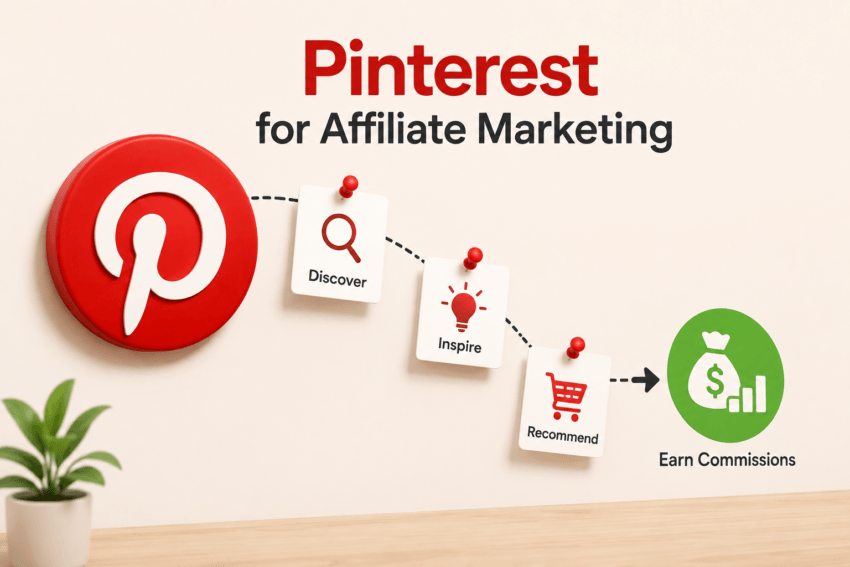
Pinterest can be much more than a place to save recipes, home ideas, and inspiration. For affiliate marketers, it can also be a useful discovery platform for surfacing helpful content and relevant product recommendations to peopleactively searching for ideas.
The key is using Pinterest as a content and discovery channel—not simply a place to drop affiliate links.
Pinterest allows affiliate content, but creators are expected to provide original value, disclose commercial relationships, avoid spammy behavior, and follow both Pinterest’s policies and the rules of individual affiliate programs.
If you are starting affiliate marketing in 2026, this guide explains how to build a practical Pinterest strategy, create better Pins, use affiliate links responsibly, and measure what works.
Affiliate Disclosure: This article contains affiliate links. If you join Wealthy Affiliate through one of my links, I may earn a commission at no additional cost to you. I recommend only products and services I have personally used or genuinely believe will add value for my readers. All opinions expressed in this review are my own.
Can You Do Affiliate Marketing on Pinterest in 2026?
Yes.
Pinterest permits affiliate marketing, provided creators follow its rules. Affiliate content should be original, useful, transparent about its commercial nature, and not posted in a repetitive or spammy way.
That means a sustainable Pinterest affiliate strategy should focus on helping the user first.
Instead of creating a Pin that simply says:
Buy This Product
create something useful, such as:
- 7 Tools That Make a Small Home Office More Organized
- Beginner’s Guide to Choosing a Travel Backpack
- 5 Meal-Prep Tools That Can Save Time
- What to Look for Before Buying a Standing Desk
The product recommendation is part of the solution, not the Pin’s sole purpose.
1. Choose a Focused Pinterest Niche
Start with a subject you can consistently create useful content around.
Pinterest covers an enormous range of interests, so trying to appeal to everyone usually makes your content less focused.
Possible affiliate-friendly topics include:
- Home organization
- DIY and crafts
- Food and cooking
- Travel planning
- Fashion and beauty
- Fitness
- Productivity
- Blogging
- Digital tools
- Small-business resources
- Personal development
- Hobbies and outdoor activities
Don’t choose a niche solely because somebody says it is profitable.
A better niche sits at the intersection of three things:
Audience interest + useful products + your ability to create credible content
Whenever possible, choose products or services you have actually used. If you haven’t used something personally, don’t pretend that you have. Explain whether your recommendation is based on research, specifications, comparisons, or another legitimate basis.
That distinction helps make your affiliate content more trustworthy.
Check the Affiliate Program Before Promoting It
Pinterest may permit affiliate links, but that does not mean every affiliate program allows its links to be promoted directly through Pinterest.
Before publishing anything, check:
- The affiliate program’s traffic-source rules
- Whether social-media promotion is allowed
- Whether direct linking is permitted
- Whether branded images or product photography can be reused
- Any required disclosure language
- Restrictions on paid advertising or trademark use
Never assume that joining an affiliate program automatically gives you permission to promote its products in every channel.
Not sure what products you should promote? Finding offers that match your niche and audience is one of the most important parts of building an affiliate strategy. Learn how to find affiliate products to promote in 2026 →
2. Use a Pinterest Business Account
For affiliate marketing, a Pinterest business account is usually the more useful option because it provides access to Pinterest Analytics and business tools.
Optimize your profile around the audience you want to reach.
Your profile should make three things obvious:
Who your content is for, what you cover, and why someone should follow you.
For example:
Practical home-office ideas, organization tips, and productivity resources for people working from home.
That’s much more useful than stuffing the bio with unrelated keywords.
Have a Website? Claim It
If you own a website, consider claiming it through Pinterest.
Claiming your website can give you additional insight into content shared from your domain and connect your Pinterest presence more closely with your website.
A website isn’t required for every Pinterest affiliate strategy, but owning one gives you much more control over your content.
3. Create Boards Around Specific User Interests
Pinterest boards help organize your content and give Pinterest context about the topics you cover.
Avoid vague board names such as:
Cool Stuff
or
Things I Like
Instead, create boards that clearly describe what someone will find there.
For example:
- Small Home Office Ideas
- Beginner Travel Packing Tips
- Easy Meal Prep Ideas
- Blogging Tools and Resources
- Small-Business Productivity Tips
Keep each board focused.
A board about home-office organization shouldn’t suddenly be filled with unrelated beauty products just because those products have affiliate programs.
Relevance matters more than trying to promote everything.
4. Create Pins That Are Useful Before They Are Promotional
Your Pin has one job: give someone a compelling reason to learn more.
That doesn’t require complicated graphics.
For standard vertical images, a 2:3 aspect ratio, such as 1000 × 1500 pixels, is a useful starting point.
A strong Pin might include:
- A clear image or illustration
- One main message
- Easy-to-read text
- A specific benefit or idea
- Consistent branding
- A destination that matches what the Pin promises
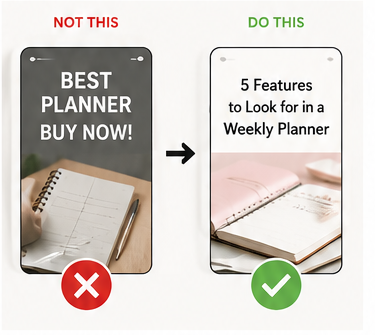
For example, instead of:
Best Planner – Buy Now
try:
5 Features to Look for in a Weekly Planner
The second version gives the user a reason to click beyond simply being sold something.
Don’t Use Images You Don’t Have Permission to Use
Joining an affiliate program doesn’t necessarily give you unrestricted rights to its logos, photography, screenshots, or other brand assets.
Use:
- Your own photography
- Your own graphics
- Properly licensed assets
- Creative materials explicitly provided for affiliates
When a merchant provides an affiliate media library, review its terms before altering those materials.
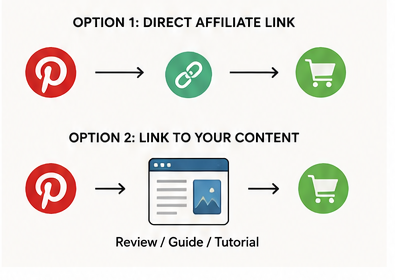
5. Direct Affiliate Links vs. Linking to Your Website
There are two common approaches.
Option 1: Direct Affiliate Linking
A Pin sends visitors directly to the merchant via your affiliate tracking link.
The advantage is simplicity.
The disadvantages are fewer opportunities to educate the reader, demonstrate experience, compare alternatives, address objections, or build a long-term audience.
You also need to confirm that the affiliate program permits the practice.
Option 2: Send Pinterest Visitors to Your Own Content
A second option is sending the visitor to a useful resource on your website, such as:
- A product review
- Comparison article
- Buying guide
- Tutorial
- Resource page
- Product roundup
The article can then include relevant affiliate recommendations.
For many affiliate marketers, this provides a stronger long-term foundation because they control the content and can offer substantially more context before asking visitors to make a purchase.
Want to turn those Pinterest clicks into better affiliate content? A useful, trustworthy review helps readers evaluate a product instead of simply pushing them to buy. Learn how to create affiliate product reviews that build trust and drive sales →
6. Make Affiliate Disclosures Obvious
Disclosure isn’t something to hide at the bottom of a page.
If you receive compensation when somebody acts on your recommendation, readers should be able to understand that relationship.
For example:
Ad — I may earn a commission if you purchase through this link.
or:
I may earn a commission from purchases made through this link.
Don’t bury the disclosure among dozens of hashtags.
And don’t assume that putting an affiliate disclosure only on your profile covers every promotional Pin.
If you’re sending Pinterest users to your website, it should also include appropriate affiliate disclosures.
7. Use Pinterest Search Intent Instead of Keyword Stuffing
Pinterest functions heavily around discovery and search.
That makes keywords useful—but the goal isn’t to repeat the same phrase everywhere.
Think about what the user is actually looking for.
Suppose your niche is home organization.
Instead of targeting only:
home organization
you could create content around searches such as:
- Small closet organization ideas
- Kitchen storage ideas
- Apartment organization tips
- Home office storage
- Decluttering checklist
Use relevant language naturally in:
- Pin titles
- Pin descriptions
- Board names
- Board descriptions
- The content on the destination page
The Pin and landing page should satisfy the same search intent.
Don’t create a Pin promising “10 Budget Kitchen Ideas” and send visitors directly to an unrelated, expensive appliance.
That may generate a click, but it doesn’t create a good user experience.
8. Build Several Useful Angles Around Important Topics
You don’t need to publish dozens of nearly identical Pins for the same affiliate offer.
Instead, approach a topic from genuinely different angles.
Suppose you’re promoting an email-marketing platform.
You might create:
Pin 1: Beginner’s Email Marketing Checklist
Pin 2: 5 Features to Compare Before Choosing Email Software
Pin 3: Email Marketing Tools for Small Websites
Each Pin serves a slightly different need.
That’s more useful than changing the background color five times and publishing essentially the same advertisement.
9. Use Both Image and Video Pins When They Fit
For 2026, think in terms of Pinterest’s current image and video Pin formats rather than building a strategy around the old Idea Pin terminology.
Video can be particularly useful when the product benefits from demonstration.
Examples include:
- Showing how an organizational product works
- Demonstrating a kitchen tool
- Walking through software features
- Showing before-and-after results
- Explaining how to use a product
However, don’t create a video simply because video exists.
Use whichever format communicates the idea most effectively.
10. Measure Outbound Results, Not Just Impressions
A Pin receiving thousands of impressions doesn’t necessarily mean it is helping your affiliate business.
For affiliate marketing, pay closer attention to what happens further down the funnel.
Useful metrics may include:
Pinterest metrics
- Impressions
- Saves
- Pin clicks
- Outbound clicks
Website metrics
- Pinterest referral traffic
- Engagement
- Landing-page performance
- Email signups
Affiliate metrics
- Affiliate-link clicks
- Conversion rate
- Sales or qualified actions
- Earnings per click, when available
The goal isn’t simply to create a “viral Pin.”
The goal is to attract the right visitor.
11. Avoid Pinterest Affiliate Marketing Shortcuts
Be cautious about strategies built around:
- Posting large quantities of near-duplicate affiliate Pins
- Creating fake accounts
- Artificially trading saves or engagement
- Hiding the commercial nature of links
- Misleading headlines
- Copying other creators’ content
- Promoting unrelated products solely for commission
- Making earnings claims you cannot support
Affiliate marketing is generally more sustainable when each Pin has a legitimate reason to exist beyond generating a commission.
12. A Simple Pinterest Affiliate Marketing Plan for Beginners
You don’t need 50 boards and hundreds of Pins before you begin.
Start smaller.
Step 1: Choose one niche
Pick one clear audience and topic.
Step 2: Join suitable affiliate programs
Check their commission structure, product relevance, reputation, tracking terms, and Pinterest/social-media rules.
Step 3: Create a Pinterest business account
Complete your profile and connect your website if you own one.
Step 4: Create several focused boards
Organize them around topics your intended audience actually searches for.
Step 5: Create useful content
Build Pins around tutorials, comparisons, checklists, ideas, problems, and buying questions, not constant sales pitches.
Step 6: Add affiliate links carefully
Use direct affiliate links only when Pinterest and the affiliate program allow them. Otherwise, send users to useful content on your website.
Step 7: Disclose commercial relationships
Make disclosures obvious and understandable.
Step 8: Review your analytics
Find the topics and Pins generating meaningful outbound engagement, then create more genuinely useful content around those themes.
Can You Make Money With Pinterest Affiliate Marketing?
It’s possible, but there is no guaranteed amount—and Pinterest traffic should not be treated as automatic passive income.
Results depend on factors such as:
- Your niche
- Audience intent
- Content quality
- Product-market fit
- Affiliate-program terms
- Conversion rates
- Competition
- Seasonal demand
- Your website or landing page
- How consistently you improve your strategy
A Pinterest account with fewer views but highly relevant visitors may generate better affiliate results than an account receiving huge numbers of low-intent impressions.
Focus on usefulness and conversions, not vanity metrics.
Frequently Asked Questions
Do I need a website for Pinterest affiliate marketing?
Not necessarily. Direct affiliate linking may be possible, but you must follow both Pinterest’s policies and the individual affiliate program’s rules. Owning a website gives you more space for reviews, comparisons, disclosures, email-list building, and original content.
Do I need thousands of Pinterest followers?
You don’t need a fixed follower count to use Pinterest for affiliate marketing. Pinterest discovery can happen through search, recommendations, and saves, not just followers.
How many Pins should I publish?
No universal number guarantees success. Focus on useful, original Pins rather than chasing an arbitrary daily quota or publishing repetitive affiliate content.
Can I put Amazon or other affiliate links directly on Pinterest?
Don’t assume you can.
Pinterest’s policies are only one part of the equation. Every affiliate network or merchant can have its own rules concerning social media traffic, direct links, trademarks, images, and disclosures. Check the current agreement for the specific program before posting.
Should every Pin contain an affiliate link?
No.
A strong affiliate Pinterest account can include tutorials, educational content, inspiration, comparisons, checklists, and other useful resources alongside commercial content.
Final Thoughts: Use Pinterest to Help Before You Sell
Pinterest affiliate marketing in 2026 isn’t about publishing as many affiliate links as possible.
A stronger strategy is to create content around questions, interests, and buying decisions your audience already has.
Choose a focused niche. Create original Pins. Recommend products that genuinely fit the content. Be transparent about affiliate relationships. Follow both Pinterest’s rules and the merchant’s affiliate terms. Then use actual performance data to decide what to create next.
That approach may take more work than dropping links everywhere, but it gives you a much stronger foundation for building trust and sustainable affiliate traffic.