


Affiliate comparison articles can be incredibly useful because they answer a question shoppers often have right before making a decision:
Which option is better for me?
A good comparison article does more than put two products side by side. It explains meaningful differences, identifies trade-offs, and helps readers choose based on their needs, budget, and priorities.
That usefulness can also make comparison content valuable for affiliate marketers. Someone searching for “Product A vs. Product B” may already understand the category and be narrowing down their options.
But there is an important distinction: your article should help the reader decide first, and generate affiliate clicks second.
In this guide, I’ll walk you through creating affiliate comparison articles that are useful, transparent, SEO-friendly, and designed to earn readers’ trust.
Affiliate Disclosure: This article contains affiliate links. If you join Wealthy Affiliate through one of my links, I may earn a commission at no additional cost to you. I recommend only products and services I have personally used or genuinely believe will add value for my readers. All opinions expressed in this review are my own.

What Is an Affiliate Comparison Article?
An affiliate comparison article evaluates two or more competing products or services to help readers decide which one better suits their needs.
Examples include:
- Product A vs. Product B
- Software A vs. Software B
- Budget Product vs. Premium Product
- Product A vs. Product B vs. Product C
Unlike a standard product review, a comparison should focus heavily on differences that affect the buying decision.
That means you don’t need to list every specification. You need to explain the specifications that matter.
For example, someone comparing two pairs of headphones might care more about comfort, noise cancellation, microphone quality, battery life, and price than small technical differences they may never notice.
The goal is simple:
Make the reader’s decision easier.
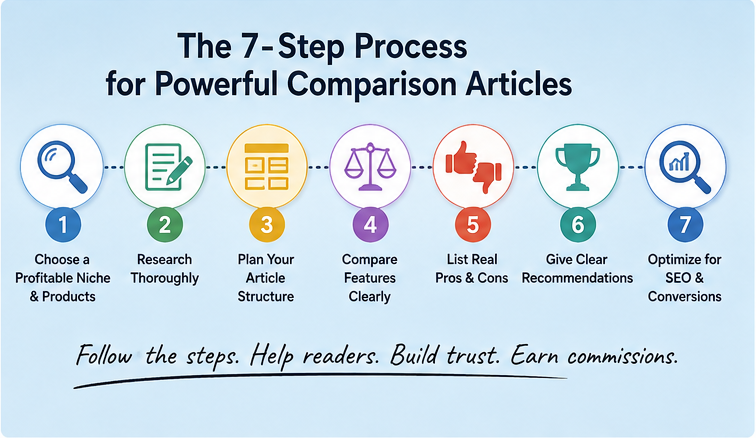
Step 1: Choose Products People Actually Need Help Comparing
Before writing anything, choose products that make sense together.
They should generally:
- Solve the same or a closely related problem
- Appeal to similar customers
- Fall within a reasonable comparison category
- Have enough meaningful differences to discuss
Don’t choose products simply because both have affiliate programs.
Start with your audience.
Ask yourself:
What would someone realistically compare before buying?
You can get ideas from Google Search suggestions, Google Trends, keyword research tools, Reddit discussions, forums, customer questions, competitor comparisons, and comments on existing content.
You may discover that readers aren’t searching for the two products you originally planned to compare. That’s useful information.
Don’t Let Commission Rates Choose the Winner
Commission rates matter to an affiliate business, but they shouldn’t determine your recommendation.
A product paying a higher commission isn’t automatically the better choice.
Instead, evaluate which product genuinely offers the strongest combination of features, value, usability, support, and other factors important to your audience.
Your recommendation becomes much more credible when readers can see how you arrived at it.
Ready to Build Your Affiliate Marketing Foundation?
Want to build an affiliate business around helpful content instead of random promotions?
Explore Wealthy Affiliate and learn how to build your affiliate marketing business →
Step 2: Research Each Product Thoroughly
This is where strong comparison articles separate themselves from thin affiliate content.
Don’t simply rewrite each manufacturer’s feature list.
Investigate what those features actually mean for the person using the product.
Depending on the type of product you’re comparing, research:
- Core features
- Current pricing
- Performance
- Ease of use
- Setup
- Compatibility
- Limitations
- Warranty
- Return policies
- Customer support
- Subscription requirements
- Important upgrades or add-ons
- Common customer complaints
- Differences from previous versions
Always verify time-sensitive details, especially prices, features, subscription plans, warranties, and availability, before publishing.
Products and services change. Your comparison should reflect what readers can actually buy today.
Firsthand Experience Is Valuable—But Don’t Pretend You Have It
If you’ve personally used both products, say so and explain how you evaluated them.
Your original observations can be one of the strongest parts of the article.
Instead of simply saying Product A is easier to use, explain why.
For example:
I found Product A easier to set up because the initial configuration required fewer steps, while Product B gave me more customization options but took longer to configure.
Whenever appropriate, include original evidence such as your own photos, screenshots, test results, measurements, performance observations, or examples of how you used the product.
But what if you haven’t personally used one or both products?
You can still create useful researched content, but don’t write as though you tested something you didn’t.
Make the distinction clear.
For example:
I haven’t personally tested Product B, so this performance comparison is based on manufacturer documentation and independently published information.
Transparency is far more valuable than manufactured experience.
Step 3: Decide What Actually Matters to the Buyer
One of the easiest ways to create a boring comparison article is to compare everything equally.
Not every feature deserves the same weight.
Instead, identify the major decision factors.
For software, these could include price, ease of use, integrations, automation, customer support, reporting, and scalability.
For headphones, they might include sound, comfort, noise cancellation, battery life, microphone quality, portability, and price.
For web hosting, they might include performance, reliability, support, ease of use, security features, and renewal pricing.
These categories give your article structure while keeping it focused on the reader’s actual decision.
Step 4: Create a Quick Comparison Table
Readers shouldn’t have to reach the bottom of a long article before discovering your conclusion.
Give them a quick overview early on.
| Category | Product A | Product B |
|---|---|---|
| Best for | Beginners | Advanced users |
| Ease of use | Excellent | Good |
| Advanced features | Good | Excellent |
| Price | $$ | $$$ |
| Support | Email + chat | Email + chat |
| Our pick for | Simplicity | More control |
Then explain the details throughout the article.
A comparison table should summarize your analysis—not replace it.
Step 5: Compare Products Feature by Feature
Instead of writing two separate mini-reviews, compare the products directly within each important category.
For example, under Ease of Use, discuss Product A and Product B together.
Which is easier to set up? Which has the simpler interface? Does one provide more control at the cost of a steeper learning curve?
Then provide a short conclusion:
Ease-of-Use Winner: Product A
Explain exactly why.
Repeat this approach for your major categories. This structure makes it much easier for someone to understand the trade-offs.
Step 6: Include Real Pros and Cons
No legitimate product is perfect for everyone.
That’s why a comparison where one product has ten advantages and virtually no disadvantages can feel more like advertising than analysis.
Product A
Pros
- Easy to use
- Lower starting price
- Good choice for beginners
Cons
- Fewer advanced features
- Limited customization
- May not suit larger teams
Product B
Pros
- More advanced tools
- Greater customization
- Better suited to complex workflows
Cons
- Higher price
- Steeper learning curve
- More features than some beginners need
The disadvantages can actually make your recommendation stronger.
They help readers understand who shouldn’t buy the product, which is often just as useful as explaining who should.
Step 7: Give Different Readers Different Winners
Not every comparison needs one universal winner.
In many cases, the most useful conclusion looks like this:
Best for beginners: Product A
Best for advanced users: Product B
Best value: Product A
Best for customization: Product B
That’s more helpful than declaring one product “the best” without context.
Explain the reasoning behind every winner.
Your conclusion should follow naturally from the evidence presented throughout the article.
Step 8: Optimize for Search Without Writing for Robots
SEO matters, but don’t stuff awkward keyword phrases throughout the page simply because you’re trying to rank for them.
Write naturally.
A comparison article might target searches such as:
- Product A vs. Product B
- Product A or Product B
- Product A compared with Product B
- Is Product A better than Product B?
- Product A alternatives
- Best Product A alternative
Your exact keywords will depend on the products you’re reviewing.
Optimize the Basics
Include your primary search topic naturally in your:
- SEO title
- Main heading
- URL slug
- Introduction
- Relevant subheadings
- Meta description
- Image alt text when it accurately describes the image
You can also link to relevant internal articles, such asproduct reviews, tutorials, and related comparisons.
But remember: optimization won’t compensate for a comparison that doesn’t offer anything useful.
Original analysis comes first.

Step 9: Strengthen E-E-A-T With Evidence and Transparency
Google commonly discusses content quality through the concepts of Experience, Expertise, Authoritativeness, and Trustworthiness (E-E-A-T).
You don’t strengthen these signals by simply writing, “I’m an expert.”
Show readers why they should trust the comparison.
Who Wrote the Article
Use a clear author byline and an author bio explaining relevant experience.
How You Evaluated the Products
Explain your comparison methodology.
For example:
How I compared these products: I evaluated both options based on pricing, ease of use, core features, support, and suitability for beginners. I checked pricing and feature information against the companies’ official information before publication.
Evidence of Firsthand Testing
If you personally tested the products, show evidence where useful.
Photos, screenshots, measurements, and specific observations can make a comparison far more valuable than generic product descriptions.
Sources
When you haven’t tested something yourself, use credible sources for factual claims.
Avoid turning somebody else’s opinion into your own experience.
Step 10: Handle Customer Reviews Carefully
Customer feedback can help you identify recurring concerns and patterns worth investigating.
But don’t cherry-pick one enthusiastic review and present it as proof that everyone loves a product.
Look for recurring themes.
For example:
A recurring concern among customer feedback is the complexity of the initial setup.
Then investigate whether that concern is supported by other reliable information or your own testing.
Whenever you quote another source directly, attribute it appropriately and keep quotations limited to what is necessary.
Your article should primarily contain your analysis, not a collection of other people’s reviews.
Step 11: Use Structured Data Correctly
Structured data can help search engines understand certain information on a page and may make eligible pages available for enhanced search appearances.
But there’s an important distinction:
Adding schema does not guarantee better rankings or a rich result.
For editorial product review pages, appropriate Product and Review structured data may be relevant depending on the content and implementation.
The important rule is simple:
Only mark up information that actually appears on the page and accurately represents the content.
Don’t create ratings, reviews, prices, or other information solely for schema markup.
Step 12: Make Affiliate Disclosures Clear
Transparency isn’t something to hide in your footer.
If you earn a commission when someone purchases through a link, make that relationship clear to readers.
A straightforward disclosure might say:
Affiliate Disclosure: This post contains affiliate links. If you purchase through one of these links, I may earn a commission at no additional cost to you.
Place disclosures where readers are likely to notice them, and make the relationship between your recommendations and affiliate links clear.
Depending on your audience, location, affiliate program, and platforms, additional requirements may apply.
Always review the current terms of the affiliate programs you participate in.
Special Note for Amazon Associates
If you participate in Amazon Associates, follow Amazon’s current disclosure and identification requirements rather than relying solely on a generic affiliate disclosure.
Program requirements can change, so verify the current requirements before publishing.
Step 13: Write CTAs That Help Instead of Pressure
A good affiliate CTA tells readers what happens when they click.
Instead of something aggressive like “BUY THIS NOW,” try:
Check the latest price for Product A →
See Product B’s current features and plans →
Compare the latest Product A options →
The CTA becomes a useful next step rather than a hard sell.
Place CTAs where they make sense, such as after you’ve explained why a particular product is suited to a particular reader.
A Simple Affiliate Comparison Article Template
Here’s a structure you can reuse:
Introduction
Explain what you’re comparing and who the comparison is for.
Affiliate Disclosure
Clearly explain your affiliate relationship.
Quick Verdict
Give readers the short answer.
Choose Product A if: …
Choose Product B if: …
Comparison Table
Summarize the important differences.
Product A Overview
Explain what it is and who it’s designed for.
Product B Overview
Do the same.
Feature-by-Feature Comparison
Compare the major buying factors directly.
Pros and Cons
Give balanced advantages and disadvantages.
Pricing and Value
Explain pricing and value rather than simply listing numbers.
Who Should Choose Product A?
Identify the ideal user.
Who Should Choose Product B?
Identify the ideal user.
Final Verdict
Summarize the differences and make a clear recommendation.
CTA
Give the reader an obvious, relevant next step.
Common Affiliate Comparison Article Mistakes
Even a well-written comparison can lose credibility if the fundamentals are wrong.
Choosing the Winner Based on Commission
Recommend what’s best for the reader, not what’s most profitable for you.
Pretending You’ve Used Products You Haven’t
Research is fine. Fake firsthand experience isn’t.
Copying Manufacturer Descriptions
Readers can find specifications elsewhere. Give them analysis they can’t get from a spec sheet.
Hiding Important Drawbacks
Explain weaknesses clearly.
Using Outdated Prices
Prices and plans change frequently. Verify them and consider using language such as “starting at” or directing readers to check the latest price when appropriate.
Making Every Category a Tie
A comparison should help readers make decisions. If one product genuinely performs better in a category, say so and explain why.
Overloading the Article With Affiliate Links
More links don’t automatically mean more conversions. Place links where they’re useful and relevant.
Burying the Affiliate Disclosure
Make your financial relationship easy to understand.
Frequently Asked Questions
Do I Need to Personally Test Every Product I Compare?
Firsthand testing can significantly strengthen a comparison, but it isn’t always possible. If you haven’t personally used a product, be transparent about that and distinguish researched information from your own experience.
Never imply that you tested something you didn’t.
How Many Products Should I Compare?
Two products work particularly well for a direct “A vs. B” article.
Three or more can work when readers choose among several close alternatives, but keep the comparison easy to follow.
Should I Include Prices?
Pricing can be useful, but it can also change quickly.
Verify prices before publishing and provide the date checked when appropriate. For frequently changing products or services, it may be safer to direct readers to the provider for current pricing than to present a price as permanent.
Should Every Comparison Have One Winner?
No.
One product may suit beginners better, while another suits advanced users.
That’s often a more useful conclusion than forcing one overall winner.
How Often Should I Update Comparison Articles?
No single schedule works for every niche.
Update an article whenever important information changes, such as pricing, features, product versions, availability, affiliate program terms, warranties, or return policies.
High-traffic and fast-changing comparisons may deserve more frequent reviews.
Final Thoughts: Help the Reader Make the Right Choice
The best affiliate comparison articles don’t feel like advertisements.
They feel like advice from someone who has done the homework.
Research carefully. Compare the factors that actually matter. Show evidence when you have firsthand experience. Clearly distinguish research from personal testing. Explain disadvantages. Disclose affiliate relationships. And recommend the product that makes the most sense for each type of reader.
When readers can understand not only what you recommend but why you recommend it, your content becomes more useful—and more trustworthy.
That is the foundation of affiliate content that can continue delivering value long after you hit publish.
Ready to Build More Helpful Affiliate Content?
You don’t need hundreds of comparison articles to get started. You need a useful niche, a repeatable research process, and content that genuinely answers the questions people are searching for.
Explore Wealthy Affiliate and start building your affiliate marketing business →