
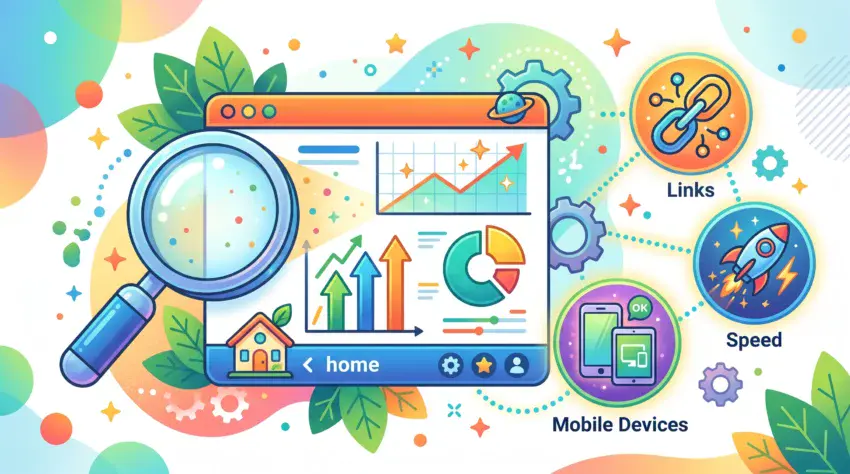
SEO can sound complicated when you’re starting a website or blog, but the fundamentals are easier to understand than many people think.
SEO—search engine optimization—is the process of helping search engines understand your pages while making it easier for people searching for that information to discover them.
It isn’t about tricking Google, repeating keywords a certain number of times, or finding a secret formula that guarantees first place.
In 2026, effective SEO still starts with useful content, a technically accessible website, and a good experience for visitors.
Here’s where beginners should focus.
Affiliate Disclosure: This article contains affiliate links. If you join Wealthy Affiliate through one of my links, I may earn a commission at no additional cost to you. I recommend only products and services I have personally used or genuinely believe will add value for my readers. All opinions expressed in this review are my own.
What Is SEO?
Search engines discover pages, process their content, and decide which results may be useful for a particular search.
SEO helps make that process easier.
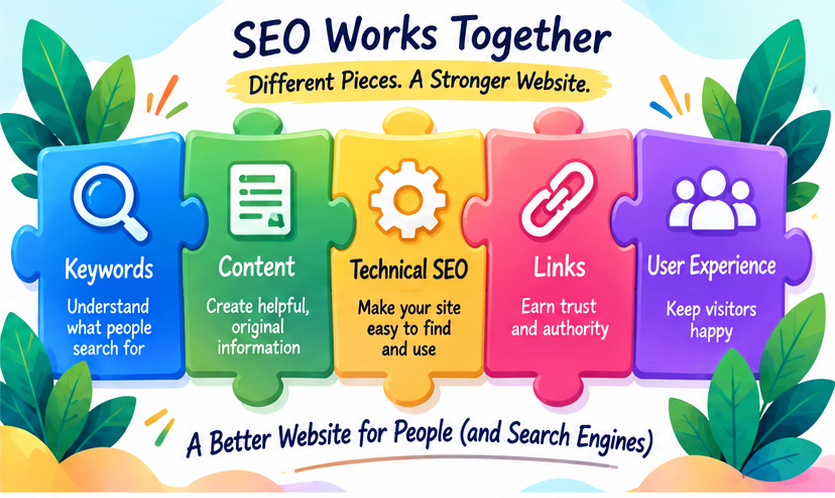
For beginners, think about SEO in four broad areas:
Content and On-Page SEO
This includes your articles, titles, headings, internal links, images, and how well a page answers the reader’s question.
Technical SEO
Technical SEO helps search engines access and understand your website. It includes crawlability, indexing, site structure, mobile usability, performance, HTTPS, and related technical considerations.
Off-Page SEO
This includes links and legitimate mentions from other websites that can help people and search engines discover your content and understand its reputation.
User Experience
Visitors should be able to navigate your site, find the main content, read it comfortably, and use the website across different devices.
You don’t need to master everything at once.
Step 1: Understand What Your Audience Searches For
Keyword research still matters—but don’t treat keywords as instructions for how many times a phrase must appear.
Start by understanding search intent.
Ask:
What is this person actually trying to accomplish?
Someone searching “how to make sourdough bread” probably wants instructions.
Someone searching “best bread maker for beginners” is more likely comparing products.
Potential research sources include:
- Google Search suggestions
- Google Trends
- Google Keyword Planner
- Search Console
- Third-party keyword tools
- Forums and communities
- Questions from your actual audience
Use these sources to understand your readers—not simply to find phrases to repeat.
Step 2: Create Content Worth Finding
Useful content remains at the center of SEO.
Aim to create pages that are:
- Original
- Accurate
- Easy to understand
- Well organized
- Appropriate for the intended audience
- Substantial enough to answer the question
- Supported by reliable sources when necessary
Don’t write to an arbitrary word count.
A simple question may need a short answer. A complicated tutorial might require considerably more detail.
Add something meaningful whenever possible: firsthand experience, original examples, photographs, testing, analysis, data, or a clearer explanation.
Step 3: Optimize Titles and Headings Naturally
Your page title and main heading should clearly explain what the content is about.
If your target phrase fits naturally, using it in prominent locations can help readers and search engines understand the page.
But you don’t need to force the exact keyword into every heading or repeatedly insert it throughout the article.
Search engines can understand related language and context.
Prioritize clarity over repetition.
Step 4: Use Internal Links
Internal links connect related pages on your website.
For example, an article about starting a blog could naturally link to another guide about choosing a blog niche or affiliate marketing.
Good internal links can:
- Help visitors discover related information.
- Help search engines find pages.
- Clarify relationships between topics
- Make navigation easier
Use descriptive anchor text rather than vague wording such as “click here” whenever practical.
Want more beginner-friendly help building your website? Explore the blogging, affiliate marketing, and online-business guides at EasyMonitize.
Step 5: Make Sure Search Engines Can Access Your Site
Great content can’t perform in search if search engines can’t properly access or index it.
For a small website, check that:
- Important pages are accessible through normal links
- You haven’t accidentally blocked important content
- Pages return appropriate status codes
- Your site uses HTTPS
- Navigation is logical
- Important content is available in readable text
- Duplicate URLs are handled appropriately
Google Search Console is particularly useful here.
It can help you understand indexing, search performance, and certain technical problems directly from Google Search data.
Step 6: Improve Page Experience
Your website should work well for real visitors.
Pay attention to:
- Mobile usability
- Readable text
- Clear navigation
- Intrusive pop-ups
- Page performance
- Visual stability
- Secure browsing
- Accessibility
Core Web Vitals can provide useful performance measurements, but don’t obsess over achieving perfect scores while ignoring the rest of the visitor experience.
Think about the page as a whole.
Step 7: Optimize Images for People First
Images can improve an article when they genuinely help readers understand the content.
Use sensible file sizes and formats so unnecessarily large images don’t slow the page.
Alt text should primarily communicate useful information about an image for people who cannot see it.
Don’t stuff keywords into alt text.
Decorative images may not require descriptive alt text at all.
Step 8: Earn Useful Links and Mentions
Backlinks—links from other websites—can be valuable, but beginners shouldn’t treat SEO as a race to collect as many links as possible.
Good links can come from:
- Genuine editorial references
- Original research or resources
- Relevant partnerships
- Useful contributions
- Digital PR
- Legitimate industry or local listings
Avoid buying links or participating in manipulative link schemes intended primarily to influence rankings.
A new website can still create useful content before it has accumulated many backlinks.

Step 9: Understand Structured Data
Structured data, often called schema markup, gives search engines machine-readable information about certain page content.
Eligible implementations can help pages qualify for supported search features.
But there are two important words:
Can qualify.
Adding schema doesn’t guarantee a rich result or higher ranking.
Only use structured data that accurately represents visible content and follows the requirements for that particular search feature.
Step 10: Update Content When It Actually Needs Updating
Your original articles shouldn’t be changed simply to make them look fresh.
Review important content periodically and update it when:
- Facts have changed
- Products have been discontinued
- Screenshots are outdated
- Recommendations no longer make sense
- Links are broken
- Better information has become available
Don’t change publication dates merely to create the appearance of freshness.
A meaningful update is different from a cosmetic date change.
SEO, E-E-A-T, and Trust
E-E-A-T means:
Experience, Expertise, Authoritativeness, and Trustworthiness.
E-E-A-T itself isn’t one specific Google ranking factor.
Instead, Google uses various signals associated with these qualities, with trust being particularly important.
For publishers, credibility can be strengthened through:
- Clear author information
- Firsthand experience when relevant
- Reliable sourcing
- Transparent review methods
- Accurate claims
- Appropriate disclosures
- Corrections when mistakes occur
Never pretend you’ve tested a product, visited a location, or achieved a result when you haven’t.
Trust becomes particularly important for subjects that can significantly affect someone’s health, finances, or safety.
What About AI Search in 2026?
AI Overviews, AI Mode, and other generative search experiences have changed how people discover information.
That doesn’t mean traditional SEO fundamentals have disappeared.
Google’s current guidance says its established SEO best practices remain relevant to generative AI search.
You don’t need a special writing formula simply because AI is involved.
Instead, focus on content that offers something beyond a generic summary:
- Firsthand experience
- Original research
- Unique analysis
- Useful images or videos
- Clear explanations
- Expert perspective
- Reliable sourcing
Google also says there is no special schema markup required for its generative AI search features.
Can You Use AI to Create SEO Content?
Yes, AI can assist with tasks such as:
- Brainstorming
- Research organization
- Outlines
- Editing
- Topic exploration
- Repetitive workflows
But AI output still needs human judgment.
Verify facts and sources. Remove generic filler. Add original value. Make sure the finished page genuinely helps its intended reader.
Using automation or AI to generate many pages without adding value can run afoul of Google’s scaled-content-abuse policy.
Beginner SEO Checklist for 2026
Before publishing an important page, ask:
- Does this page satisfy a real audience need?
- Is the information accurate and original?
- Does the title clearly describe the page?
- Are headings useful and logically organized?
- Are related pages internally linked?
- Can search engines access the page?
- Does it work well on mobile devices?
- Are images appropriately optimized?
- Is alt text useful where needed?
- Are important claims properly supported?
- Does structured data, if used, match visible content?
- Have I checked the site in Search Console?
- Does the page offer something beyond generic AI-generated information?
You don’t need to make every page perfect.
Use the checklist to catch meaningful problems.
How Long Does SEO Take?
There is no guaranteed SEO timeline.
Results can depend on your website, competition, content, technical condition, search demand, links, reputation, and many other factors.
A page might gain visibility relatively quickly, take considerably longer, or never achieve meaningful search traffic.
Even following Google’s best practices doesn’t guarantee crawling, indexing, or rankings.
Instead of waiting for a specific deadline, monitor progress.
Use Search Console to evaluate impressions, clicks, queries, pages, and indexing information.
Use an analytics platform to understand what visitors do after arriving on your site.
Frequently Asked Questions
Is SEO still worth learning in 2026?
Yes. SEO fundamentals remain relevant to traditional Google Search and Google’s generative AI search experiences.
Do I need paid SEO tools?
No. Paid tools can make research and analysis easier, but beginners can learn a great deal using Search Console and other free resources. Be cautious of third-party tools promising guaranteed rankings; Google notes that these services don’t have access to its internal ranking systems.
How many keywords should I use?
There is no required number. Write naturally about the subject and use descriptive language that helps readers understand the page.
Do I need backlinks?
Links can help with discovery and reputation, but don’t manufacture links simply to manipulate rankings. Focus on creating material worth referencing and promoting it appropriately.
Final Thoughts: SEO for Beginners in 2026
SEO doesn’t require mastering hundreds of ranking factors.
Start with the fundamentals:
Understand your audience. Create genuinely useful content. Make your website accessible. Help people navigate it. Establish credibility. Measure what happens. Improve what matters.
Google’s own guidance emphasizes helpful, reliable, people-first content and says there is no secret that automatically ranks a website first.
AI will continue changing how people search, but chasing every new SEO hack isn’t a sustainable strategy.
Build a website that deserves to be discovered.
Ready to keep growing your site? Visit EasyMonitize for practical guides on blogging, SEO, affiliate marketing, content creation, and building a sustainable online business.