


“Make money while you sleep.”
That’s probably the phrase you’ve heard attached to passive income.
It sounds great. It’s also an easy way to get the wrong idea.
Passive income usually isn’t money appearing with no work. Most opportunities require money, time, skills, an asset, or significant work upfront. Many require maintenance afterward, too.
So, what is passive income?
In everyday terms, it’s income that isn’t completely dependent on continuously trading another hour of your time for another hour of pay.
That distinction matters.
Affiliate Disclosure: This article contains affiliate links. If you join Wealthy Affiliate through one of my links, I may earn a commission at no additional cost to you. I recommend only products and services I have personally used or genuinely believe will add value for my readers. All opinions expressed in this review are my own.
How Does Passive Income Actually Work?
Think about a freelancer and someone selling a digital template.
The freelancer completes a project and gets paid. To earn again, they generally need another project.
The template creator may spend hours making a product once and potentially sell copies afterward without rebuilding it for every customer.
That sounds more passive—but someone still has to create the product, attract buyers, pay platform fees, answer questions, update listings, and deal with competition.
Think of passive as a spectrum, not an on/off switch.
And one important note: “passive income” in casual conversation isn’t necessarily the same as a passive activity for tax purposes. Tax definitions vary by jurisdiction and can follow very specific rules.

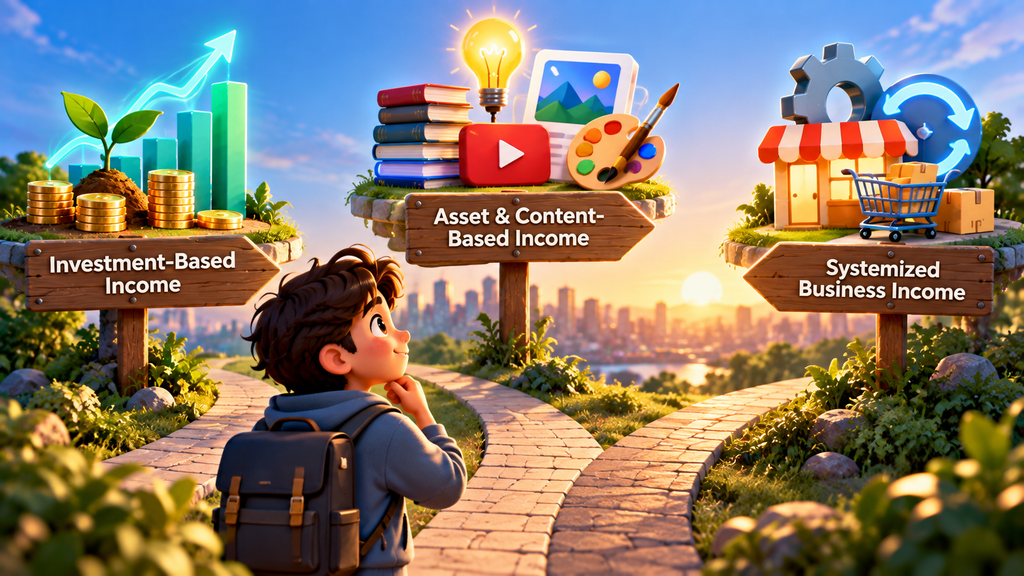
3 Main Types of Passive Income
Instead of lumping every money-making idea together, it helps to separate them.
1. Investment-Based Income
This involves putting capital into an asset that may generate income or increase in value.
Examples include:
- Dividend-paying stocks
- Bonds and interest-bearing investments
- Certain funds
- Real estate investment trusts (REITs)
These can require relatively little day-to-day involvement, but that doesn’t make them risk-free.
Dividends and fund distributions aren’t guaranteed. Investments can lose value, fees reduce returns, and tax treatment varies.
Low effort doesn’t mean low risk.
2. Asset and Content-Based Income
Here, you create or own something that can potentially generate revenue more than once.
Examples include:
- Digital products
- Books and ebooks
- Online courses
- Photography or illustrations
- Blogs
- Affiliate content
- Videos with ongoing views
This is where “passive income” gets exaggerated most often.
A blog, for example, can earn from older articles. But those articles may lose rankings, affiliate programs can change, products disappear, and competitors can publish something better.
Digital products face similar challenges.
You may create the product once, but sales are never guaranteed.
3. Systemized Business Income
Some businesses can eventually be structured so the owner doesn’t personally perform every task.
Examples might include ecommerce operations, subscription businesses, licensing arrangements, or businesses with employees and automated systems.
But automation isn’t the same as passivity.
Inventory problems, refunds, advertising, customers, suppliers, taxes, platform policies, and cash flow don’t disappear because software handles part of the workflow.
That’s why I’d be especially careful about calling dropshipping or print-on-demand passive income. They’re businesses first.
Want to explore realistic ways to build income online? Visit EasyMonitize for beginner-friendly guides on blogging, affiliate marketing, SEO, AI tools, and building an online business.
What Are Realistic Passive Income Ideas for Beginners?
There isn’t one “best” option. A better choice depends on what you already have.
If you have money but limited time: investment-based options may be worth researching.
If you have knowledge: a useful guide, template, course, or other educational product could become an asset.
If you enjoy creating content: blogging, video, or affiliate content can potentially generate recurring revenue—but building an audience usually takes considerable work.
If you have creative skills: photography, illustrations, templates, or other licensed or downloadable assets may be worth exploring.
Don’t choose something simply because somebody calls it passive.
Ask:
Why would someone pay for this?
If there’s no convincing answer, automation won’t fix the business model.
Where Does AI Fit Into Passive Income?
AI can reduce the time required for certain tasks.
It can help brainstorm ideas, organize research, analyze information, draft outlines, create design concepts, support customer-support workflows, or repurpose content.
What it can’t do is guarantee demand.
Uploading hundreds of AI-generated ebooks, images, articles, or print-on-demand designs isn’t automatically a passive-income strategy.
You also need to consider other issues.
AI-generated material can contain factual errors. Commercial-use terms differ between tools. Marketplaces may impose their own AI rules. Copyright protection can depend on jurisdiction and the amount of human authorship involved.
In the United States, for example, copyright protection continues to depend on human authorship; simply generating material with AI does not automatically make the generated material independently copyrightable. U.S. Copyright Office
And never casually upload confidential customer, employer, or client information into an AI service without understanding the applicable privacy terms and permissions.
Use AI to improve a legitimate workflow—not to manufacture an imaginary business.
How Much Can You Make From Passive Income?
There is no meaningful universal number.
Someone with substantial invested capital is in a completely different position from someone starting a blog with a small budget.
A digital product could sell hundreds of copies—or none.
An affiliate article could generate commissions—or never receive meaningful traffic.
A rental property could generate positive cash flow while another loses money after financing, maintenance, vacancies, taxes, insurance, and repairs.
Instead of focusing on screenshots of somebody else’s revenue, calculate:
Revenue – fees – operating expenses – taxes – losses – your ongoing time = what you’re actually getting from the opportunity
Revenue alone can make a mediocre business look impressive.
How to Start Building Passive Income
Start with one stream, not seven.
First, decide what you’re willing to invest: money, time, skills, or some combination.
Then ask four questions:
- Where does the money actually come from?
- What does it cost to create or acquire the asset?
- What ongoing work will it require?
- What could cause the income to disappear?
Those questions aren’t particularly exciting.
They’re much more useful than asking which passive-income idea will make money fastest.
Once something genuinely works, you can decide whether diversification makes sense.
Watch Out for Passive Income Scams
“Passive income” is powerful marketing language—which is exactly why scammers use it.
Be skeptical of opportunities promising:
- Guaranteed income
- Large returns with little effort
- Fully automated stores
- Secret AI systems
- “Done-for-you” businesses
- Expensive coaching required to unlock the system
- Pressure to buy immediately
The FTC has pursued schemes accused of making deceptive passive-income claims around supposedly automated or AI-powered e-commerce businesses. Federal Trade Commission
A legitimate opportunity should survive basic questions about what you’re selling, who buys it, why they buy it, what it costs, and how the business actually makes money.
If those answers are vague but the income promises are incredibly specific, that’s a warning sign.
What About Taxes?
Income doesn’t become tax-free because someone calls it passive.
Taxes depend on your country, income type, business structure, expenses, investments, and other circumstances.
Keep accurate records of income and expenses and check the rules that apply where you live. When the amounts become meaningful, or the situation gets complicated, consider speaking with a qualified tax professional.
Is Passive Income Really Passive?
Sometimes it’s more passive, not completely passive.
Investments may require little ongoing work but require capital and involve risk. Digital assets may continue selling after they’re created but need marketing and maintenance. Businesses can become increasingly systemized but still require oversight.
That’s a more realistic definition than “money for doing nothing.”
Final Thoughts: Build Assets, Not Passive-Income Fantasies
Passive income can be useful, but the phrase often distracts from what actually creates it.
Someone usually had to invest something first.
That might be money. It might be months of work. It might be expertise, intellectual property, an audience, a business system, or an asset.
Instead of asking:
“How can I make money without working?”
Try asking:
“What can I build or own today that may continue creating value tomorrow?”
That’s a much better place to start.
Want to build an online income stream without the easy-money promises? Explore EasyMonitize for practical guides on blogging, affiliate marketing, SEO, AI tools, and building an online business.