

You’ve got an online business idea. Maybe it’s a digital product, a freelance service, or a website you’ve been thinking about starting.
You’re excited enough to start building it.
But there’s one question worth answering first:
Does anyone actually want what you’re planning to offer?
It’s easy to spend weeks building a website, designing a product, or planning a business, only to discover that finding customers is harder than expected.
That’s why learning how to validate an online business idea matters.
And the good news? You can do much of the early research without spending money.
Here’s how to test your idea before investing heavily in it.
Affiliate Disclosure: This article contains affiliate links. If you join Wealthy Affiliate through one of my links, I may earn a commission at no additional cost to you. I recommend only products and services I have personally used or genuinely believe will add value for my readers. All opinions expressed in this review are my own.
What Does It Mean to Validate a Business Idea?
Business idea validation means gathering evidence that a specific group of people has a problem and may pay for your solution.
It isn’t about proving that your idea will succeed.
It’s about reducing uncertainty before committing more time or money.
A useful validation process examines three things:
- Demand: Do people genuinely experience the problem?
- Willingness to pay: Have they spent money on similar solutions, or will they commit to yours?
- Reachability: Can you find and communicate with potential customers?
An idea becomes more promising when you find evidence supporting all three.
Step 1: Define Your Idea in One Sentence
Before researching competitors or creating a website, get specific about your target customer.
Instead of saying:
“I want to sell digital products.”
Try:
“I want to create affordable budgeting templates for freelancers who struggle with irregular income.”
The second idea identifies a customer, a problem, and a potential solution.
You can make it even more testable by adding an estimated price.
Don’t worry about getting that price right immediately. It’s a hypothesis you’ll investigate.
Beginner tip: If you can’t clearly describe who your product helps, narrow your audience before moving forward.
Step 2: Research Demand Using Free Tools
You don’t need expensive market research software to start looking for evidence.
Begin by exploring what people already search for and discuss.
Google Search
Search for phrases related to the problem your idea addresses.
Look at autocomplete suggestions, related searches, and relevant search results.
These can reveal how people describe their needs, although they don’t establish how many people would buy your product.
Google Trends
Google Trends can help you explore relative search interest and seasonality.
However, its charts don’t represent exact search volumes or customer demand.
Use it as one source of context, not proof that a business idea is profitable.
Online Communities
Explore relevant Reddit discussions, Facebook groups, and niche forums.
Look for people who:
- Ask how to solve a recurring problem.
- Complain about existing products.
- Request recommendations.
- Describe workarounds they’ve created themselves.
Pay particular attention to repeated problems and evidence that people have already invested time or money in solving them.
Respect community rules and avoid turning research discussions into unsolicited promotions.
Step 3: Study Competitors Before Creating Anything
Finding competitors isn’t automatically bad news.
Existing products may indicate that a market exists.
However, competition alone doesn’t prove sufficient demand or profitability for your specific offer.
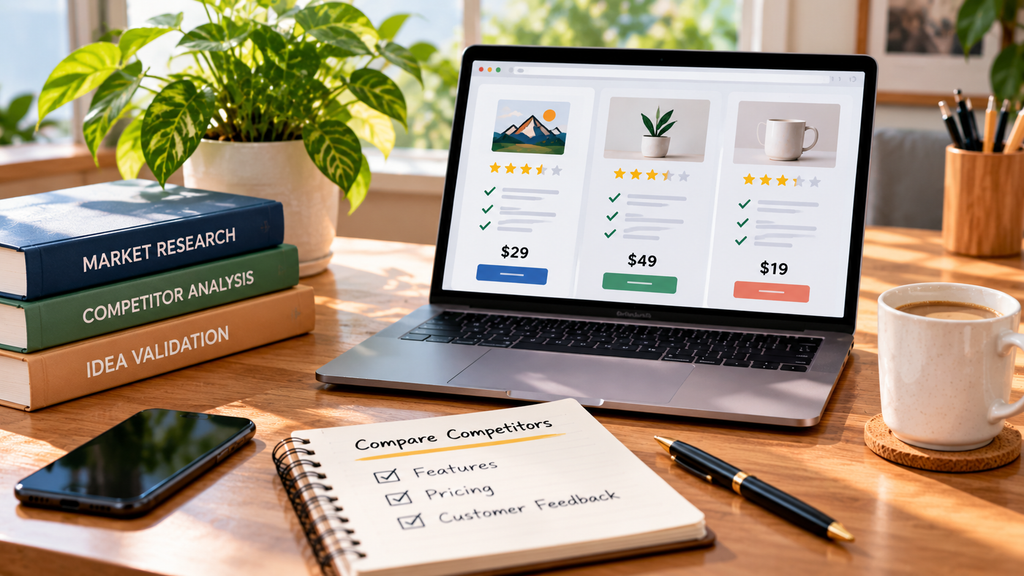
Study several alternatives and ask:
- Who are they targeting?
- What problem do they solve?
- How much do they charge?
- What do customers appreciate?
- What complaints appear repeatedly?
Customer reviews can be particularly useful.
If buyers consistently describe a product as complicated or unsuitable for beginners, it may be worth testing a simpler alternative.
Just remember that reviews aren’t always representative of the entire customer base.
Your goal is to identify a meaningful difference, not simply create another version of what’s already available.
Step 4: Talk to Potential Customers
This is where your research becomes more personal.
Talk to people who genuinely fit your target audience.
Ten conversations can be a practical starting goal, but they aren’t a statistically reliable measure of market demand.
Focus on understanding real experiences rather than collecting compliments.
Ask questions such as:
- When did you last experience this problem?
- What did you do to solve it?
- Have you paid for a solution before?
- What frustrated you about the available options?
- What would make solving this easier?
Avoid leading with “Would you buy my product?”
People may answer positively simply to be encouraging.
Instead, explore what they’ve actually done.
Someone who has repeatedly searched for solutions, built a workaround, or paid for an alternative may provide stronger evidence than someone who says your idea sounds interesting.
Step 5: Test Your Offer Before Building the Product
Once you understand the problem, create a simple way to explain your proposed solution.
You might use a free landing page, online form, or basic product description.
Include three essentials:
1. Who it’s for
Identify your intended customer.
2. What problem it solves
Explain the specific benefit without exaggerating results.
3. What happens next
Invite interested people to join a waitlist, request details, or discuss a potential purchase.
Some website and form-building tools offer free options, although features and limits can change.
A waitlist can help measure interest, but signing up doesn’t mean someone will eventually pay.
If you decide to accept preorders, clearly disclose the product’s development status, expected delivery, refund terms, and any applicable consumer rights.
Payment processing may also involve fees, so a paid test isn’t necessarily free.
Step 6: Find Out Whether People Will Pay
Interest and willingness to pay are different things.
Someone might love your idea but have no intention of purchasing it.
Look for stronger evidence.
For example:
- Have customers paid for competing solutions?
- Do they already spend significant time dealing with the problem?
- Are they willing to discuss a specific price?
- Will qualified prospects request a proposal or join a genuine purchase process?
Actual purchases generally provide stronger evidence than survey answers, but even a few sales don’t guarantee a sustainable business.
Also consider your likely costs. A product can attract buyers and still be unprofitable.

Step 7: Decide Whether to Continue, Adjust, or Stop
After gathering evidence, review what you’ve learned.
Continue Testing
Your idea may deserve further investigation if people consistently describe the problem, existing solutions attract paying customers, and potential buyers respond positively to your specific offer.
Adjust Your Idea
You may need to change your audience, pricing, or solution if the problem is real but your proposed approach doesn’t resonate.
Stop or Reconsider
If you repeatedly struggle to find evidence of a meaningful problem or genuine buying interest, consider testing a different idea.
Don’t make the decision using arbitrary numbers alone.
A small sample can miss important customer groups, and a lack of immediate responses doesn’t necessarily prove there’s no market.
The goal is to make a better-informed decision, not pretend you’ve eliminated all risk.
A Free 7-Day Business Idea Validation Plan
You can organize your first round of research into one week.
| Day 1 | Define your target customer, problem, and proposed solution |
| Day 2 | Research search results, trends, and online discussions |
| Day 3 | Compare competing products, prices, and customer reviews |
| Day 4 | Contact potential customers and request short conversations |
| Day 5 | Conduct interviews and document recurring problems |
| Day 6 | Create a simple offer page or interest form |
| Day 7 | Share your offer appropriately and review the evidence collected |
This is a starting schedule, not a deadline for proving demand.
Finding suitable interviewees and collecting meaningful responses may take longer than seven days.
That’s fine. Better evidence is more useful than rushing.
Common Business Idea Validation Mistakes
Asking only friends and family. Their encouragement may not reflect how actual customers behave.
Confusing popularity with demand. A trending topic doesn’t automatically represent a profitable market.
Building before researching. A polished website can’t compensate for an offer customers don’t want.
Treating waitlist signups as sales. Interest is useful, but purchasing behavior is stronger evidence.
Ignoring customer acquisition. Even a useful product needs a realistic way to reach potential buyers.
Making decisions too quickly. A few conversations or one unsuccessful post rarely tell the whole story.
Forgetting costs. Free research doesn’t mean your eventual business will be free to operate.
Frequently Asked Questions
Can you validate a business idea for free?
Yes. Search research, competitor reviews, customer conversations, and some free online tools can help you test early assumptions without spending money.
How many people should I interview?
There’s no universal number. Start with a manageable group of relevant potential customers and continue until you understand recurring problems and important differences between them.
Does a waitlist prove people will buy?
No. A waitlist indicates interest, not a confirmed purchase. Stronger evidence comes from genuine buying behavior and demonstrated willingness to pay.
What if nobody responds to my idea?
Review whether you’re reaching the right audience and explaining the problem clearly. Try improving your approach before concluding that the idea has no potential.
Final Thoughts: Test Before You Invest
You don’t need a perfect business plan or an expensive website to begin exploring an online business idea.
You need curiosity, a clear audience, and a willingness to listen.
Find out what people struggle with, examine what they’re already using, and test whether your proposed solution interests potential customers.
The goal isn’t to eliminate every risk.
It’s to avoid spending months building something based entirely on assumptions.
Ready to explore beginner-friendly business opportunities? Read EasyMonitize’s Online Business Ideas for Beginners for practical options to consider.
And if you’re thinking about building a content-based business, explore our Beginner’s Guide to Starting a Blog to understand the steps involved before investing in your website.